






The Complete Auto Maintenance Checklist for Fleets
Key Takeaways
- Defect reporting helps fleets identify vehicle problems early and maintain safety.
- Inspections usually occur during pre-trip, post-trip, and maintenance checks.
- Defects are commonly categorized into no defect, minor defect, and critical defect.
- Proper reporting helps fleets prioritize repairs and reduce downtime.
- Fleet management software can automate inspections, defect tracking, and maintenance scheduling.
Fleet operations rely heavily on vehicle reliability and safety. A single unnoticed defect can lead to vehicle breakdowns, accidents, regulatory penalties, or costly downtime. This is why defect reporting and severity classification are essential components of effective fleet management.
When fleets implement structured inspection processes and clearly defined defect severity levels, they can identify problems early, prioritize repairs efficiently, and maintain compliance with safety regulations.
This guide explains how defect reporting works in fleet operations, how severity levels are defined, and how fleet managers can build a system that keeps vehicles safe and operations running smoothly.
What Is Defect Reporting in Fleet Management?
Defect reporting is the process of documenting vehicle faults, damages, or mechanical issues discovered during inspections or daily operations.
Drivers, technicians, or inspectors record these defects in inspection reports so that maintenance teams can take corrective action. These reports typically include vehicle details, inspection findings, defect descriptions, and severity classifications.
A well-structured defect reporting system allows fleets to:
- Detect safety issues before they become serious problems.
- Maintain regulatory compliance for commercial vehicles.
- Ensure drivers operate safe and roadworthy vehicles.
- Reduce unexpected vehicle breakdowns.
For fleets operating large numbers of vehicles, defect reporting becomes a central part of preventive maintenance and operational efficiency.
Why Defect Reporting Matters for Fleets
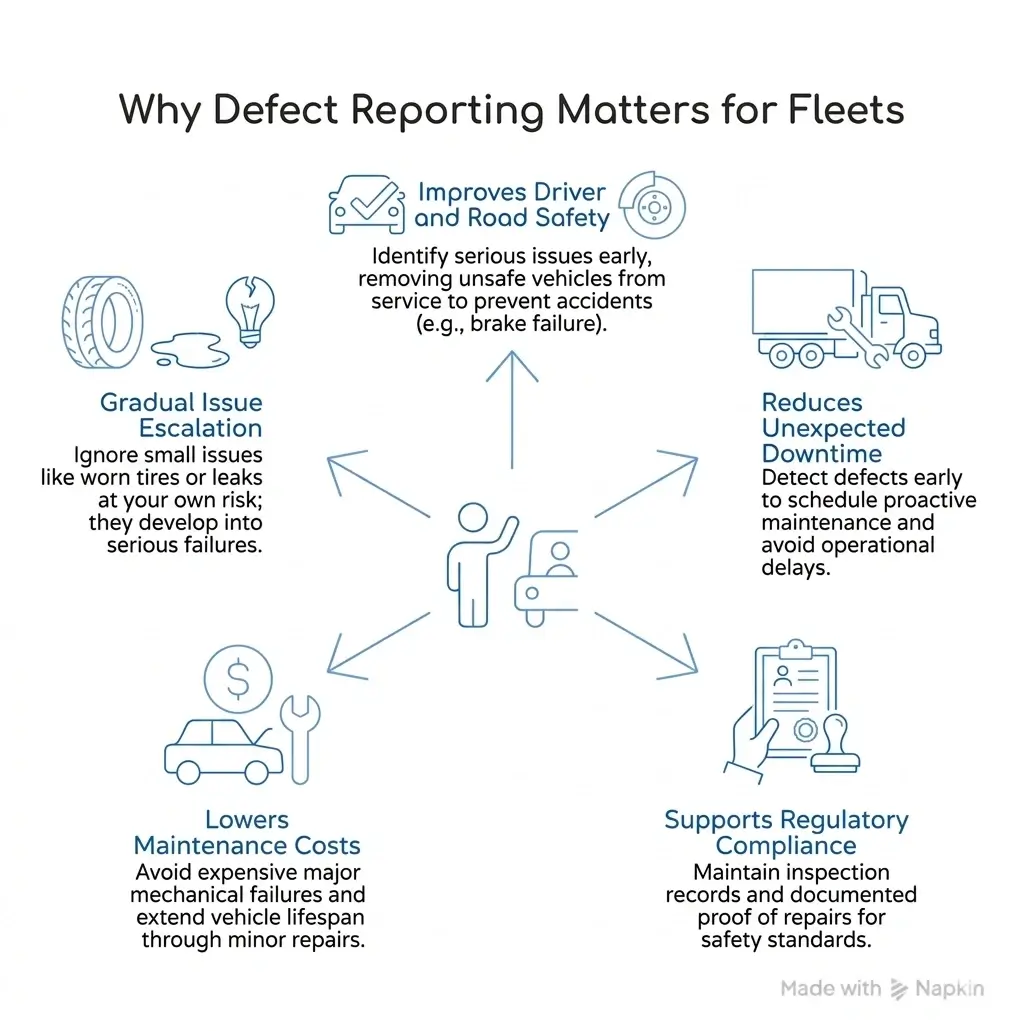
Vehicle defects often develop gradually. Small issues such as worn tires, fluid leaks, or malfunctioning lights may not immediately stop a vehicle from operating, but they can escalate into serious failures if ignored.
A consistent defect reporting process helps fleets manage these risks.
Improves Driver and Road Safety
When defects are identified early, vehicles with serious issues can be removed from service before they cause accidents. For example, detecting brake wear during inspection prevents potential brake failure during operations.
Reduces Unexpected Downtime
Vehicles that break down on the road create operational delays, disrupt schedules, and increase repair costs. Early defect detection allows fleets to schedule maintenance proactively rather than reacting to breakdowns.
Supports Regulatory Compliance
Commercial fleets must maintain inspection records to demonstrate compliance with safety standards. Defect reports provide documentation that inspections were performed and repairs were addressed.
Lowers Maintenance Costs
Minor defects are far cheaper to repair than major mechanical failures. Early detection helps fleets avoid expensive repairs and extend vehicle lifespan.
When Should Defects Be Reported?
Defects can be discovered at several stages during fleet operations. Establishing multiple inspection points ensures that issues are detected as early as possible.
Pre-Trip Inspections
Drivers inspect the vehicle before starting their route. The purpose of a pre-trip inspection is to ensure the vehicle is safe for operation.
Drivers typically check components such as:
- Tires and wheels
- Brake system
- Lights and indicators
- Mirrors and windshield
- Steering response
- Fluid levels
If a safety-critical defect is discovered, the vehicle should not be used until repairs are completed.
Post-Trip Inspections
Post-trip inspections help identify problems that occurred during the trip.
Drivers may detect issues like:
- Tire damage
- Suspension noise
- Body damage
- Fluid leaks
Documenting these defects ensures the maintenance team can address them before the next trip.
Maintenance Inspections
Technicians often identify defects during scheduled servicing or preventive maintenance checks.
These inspections are typically more detailed and may uncover deeper mechanical issues that are not visible during daily inspections.
Understanding Defect Severity Levels
Not all vehicle defects carry the same level of risk. To manage repairs efficiently, fleets classify defects based on severity.
This classification helps maintenance teams prioritize which issues must be fixed immediately and which can be scheduled later.
Defect Severity Levels Used by Fleets
Severity classification ensures that safety-critical issues receive immediate attention.
Download Your Free Inspection Checklist Now!
Prevent costly breakdowns and maximize uptime with our free checklist.
Download
Information That Should Be Included in a Defect Report
A defect report should provide enough detail for maintenance teams to diagnose and repair the issue efficiently.
A complete report usually includes several key elements.
Vehicle Identification
Fleet managers must be able to clearly identify the vehicle associated with the defect.
Important information includes:
- Vehicle ID or fleet number
- License plate number
- VIN (Vehicle Identification Number)
- Odometer reading
This information helps track defects and maintenance history for each vehicle.
Driver Information
The inspection report should record who performed the inspection.
This typically includes:
- Driver name
- Driver ID
- Date and time of inspection
- Digital signature or confirmation
Having clear accountability ensures inspections are completed properly.
Detailed Defect Description
Drivers or inspectors should describe the defect clearly so technicians understand the problem.
This may include:
- The affected component (brakes, tires, lights, etc.)
- The nature of the issue
- Whether the problem appeared suddenly or gradually
- Any unusual sounds, smells, or behavior
Clear descriptions help reduce diagnostic time.
Evidence and Documentation
Modern fleets increasingly include photographic or video evidence in inspection reports.
Images can help maintenance teams assess the severity of issues such as tire damage, leaks, or structural problems.
Common Vehicle Defects Found in Fleets
Certain defects appear more frequently in fleet vehicles due to heavy usage and high mileage.
Understanding common defect types helps fleets create targeted inspection checklists.
Safety-Related Defects
Safety defects have the highest priority because they directly affect vehicle operation.
Examples include:
- Brake wear or brake failure
- Tire damage or excessive tread wear
- Broken headlights or brake lights
- Steering system issues
Even a single safety defect can make a vehicle unsafe to operate.
Mechanical Defects
Mechanical defects may develop gradually and can lead to breakdowns if ignored.
Common examples include:
- Engine overheating
- Oil leaks
- Transmission issues
- Suspension wear
Regular inspections help detect these issues before they become serious failures.
Structural or Body Defects
These defects affect the vehicle’s structure or exterior components.
Examples include:
- Cracked windshield
- Broken mirrors
- Body panel damage
- Door or latch malfunction
Although some structural defects may not affect immediate safety, they still require repair to maintain vehicle integrity.
Best Practices for Effective Defect Reporting
Fleet managers can significantly improve safety and efficiency by implementing structured defect reporting processes.
Use Standardized Inspection Checklists
Inspection checklists ensure drivers consistently inspect the same components.
This reduces the chances of missing important safety checks.
Train Drivers on Defect Identification
Drivers are the first line of defense in detecting vehicle issues. Training programs should help drivers understand:
- What defects to look for
- How to report issues accurately
- When a vehicle should be removed from service
Proper training leads to more reliable defect reports.
Prioritize Critical Repairs
Critical defects must always be addressed immediately.
Allowing a vehicle with serious defects to remain in service increases safety risks and liability exposure.
Track Defect Trends
Fleet managers should regularly analyze defect reports to identify recurring issues.
Frequent defects in specific components may indicate:
- Poor maintenance practices
- Low-quality replacement parts
- Vehicles nearing end-of-life
Trend analysis supports better fleet planning and budgeting.
How Inspection Defects Turn Into Work Orders
Reporting a defect doesn't fix anything by itself. Unless it turns into an actual repair, all you've really done is create paperwork. Most fleets that keep getting hit with downtime don't have a defect-finding problem. They have a defect-losing problem, somewhere between the moment a driver notices something wrong and the moment a wrench actually touches the vehicle.
When the process is set up right, it goes something like this:
A driver runs through a pre-trip or post-trip check, either on paper or through an app on their phone. Something fails. Could be the tire's worn past where it should be. Could be a leak nobody's dealt with yet, or a light on the dash that just won't shut off.
Either way it gets marked minor or critical. That's mostly so the manager isn't stuck guessing whether the truck can still finish its route today or if it needs to get pulled right then.
From there someone actually has to look at it. This is where a lot of fleets quietly fall apart, because the report sits in an inbox, or a group chat, or a binder nobody opens until the next audit. If a manager reviews it, the defect turns into an issue with a status and someone's name attached to it. Not just a line on a form.
Once that's done, the issue becomes a work order. Parts, labor, what actually needs fixing, all of it laid out for whoever's doing the repair. A technician gets assigned, so it's not floating around unclaimed. They do the work, log it, and the vehicle gets cleared to go back out. At that point there's a record of what was wrong, what got fixed, and when it happened.
Here's the thing though. Every one of those steps is a handoff, and handoffs are where defects go missing. A driver reports something and nobody reviews it. A manager sees it and never turns it into a work order. A technician fixes the problem but forgets to close it out in the system. Now you've got a paper trail that shows the defect existed and nothing showing it ever got repaired, which is exactly the gap an auditor or a lawyer will find first.
Getting these steps connected, instead of leaving them scattered across a driver's phone, a manager's inbox, and a shop's whiteboard, is what actually turns inspections into a maintenance system instead of a compliance chore.
How Digital Fleet Systems Improve Defect Reporting
Manual inspection reports can be difficult to track, analyze, and store.
Fleet management software simplifies the entire defect reporting process.
Digital systems allow fleets to:
- Capture inspection data instantly
- Attach photos and evidence
- Automatically classify defect severity
- Notify maintenance teams immediately
- Track repair progress
These tools provide real-time visibility into vehicle health across the fleet.
Building a Strong Defect Management Process
For fleets managing dozens or hundreds of vehicles, defect reporting must be supported by a clear workflow.
A typical process may include:
- Driver performs inspection.
- Defect is recorded in the inspection report.
- System classifies severity level.
- Maintenance team receives notification.
- Repair work order is created.
- Technician completes repair and verifies the fix.
- Vehicle is cleared for operation.
A well-designed workflow ensures no defect goes unresolved.
Simplify Defect Reporting with Simply Fleet
Defect reporting is one of the most important safety practices in fleet operations. Without a structured system for identifying and prioritizing vehicle defects, fleets risk accidents, breakdowns, and regulatory violations.
Managing inspections, defect reports, and repairs manually can quickly become overwhelming as fleets grow.
Simply Fleet’s Fleet Management Software helps fleets streamline the entire process.
If your fleet is looking to improve safety, reduce downtime, and simplify defect tracking, Simply Fleet provides the tools needed to manage your vehicles efficiently.