





Winter Fuel Surcharge and Consumption Tracking: How to Catch MPG Drops Before They Hit Your Budget
Key Takeaways
• CIP accounting captures all costs of an asset under construction before it is ready to use
• Skipping it distorts your balance sheet and can cause compliance issues with GAAP or IFRS
• Fleet businesses are especially exposed because infrastructure costs hit multiple budget lines at once
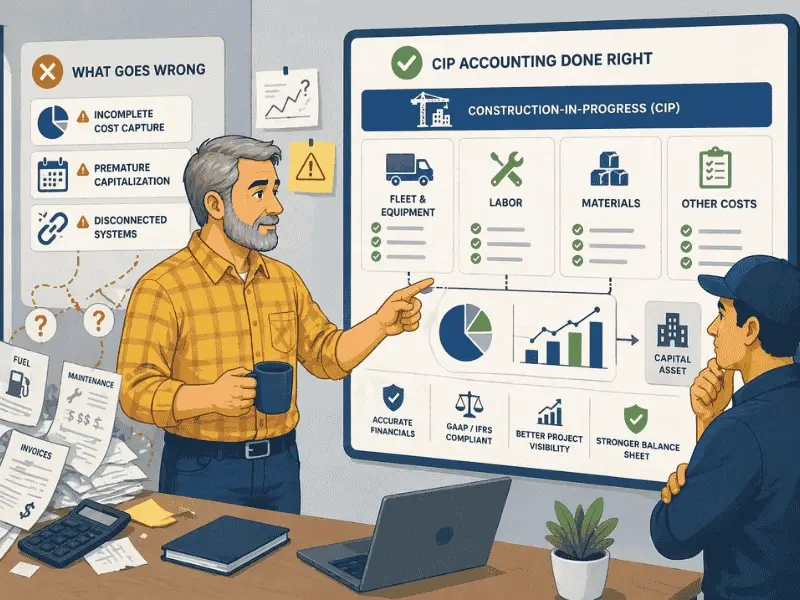
• The three most common mistakes are incomplete cost capture, premature capitalization, and disconnected systems
• Linking fleet expense tracking to project cost management closes the gap between what you spend and what you report
Most guides on CIP accounting treat it as a pure finance topic. They explain the journal entries, walk through the GAAP rules, and wrap up with a note about depreciation timing. What they don't cover is the part where things actually go wrong for operations-heavy businesses.
Fleet-driven companies, logistics operators, construction firms, businesses with depots and maintenance workshops, invest heavily in physical infrastructure. A fuel station, a vehicle yard, a service bay. These assets take months to build and involve dozens of cost lines: contractors, equipment, fuel, permits.
When those costs aren't tracked properly under CIP accounting, the result isn't just a technical accounting error. It's a financial picture that doesn't match reality.
If your business runs heavy logistics operations or similar infrastructure-heavy workflows, these gaps show up faster and hit harder.
When I was researching this topic, the thing I couldn't find anywhere was a clear explanation of why fleet businesses specifically get this wrong, not what the rule is, but where the process breaks down in practice. That's what this guide is built around.
What CIP Accounting Actually Is
Construction-in-Progress (CIP) accounting is the method of recording all costs associated with building or developing a long-term asset before it becomes operational. Until the asset is ready for use, those costs live in a CIP account on the balance sheet, classified as a fixed asset but not yet depreciated.
For a fleet business, assets that commonly pass through CIP include:
- Maintenance workshops and service bays
- Vehicle storage yards and depots
- On-site fuel stations
- Wash bays and inspection facilities
- Driver rest facilities and dispatch centres
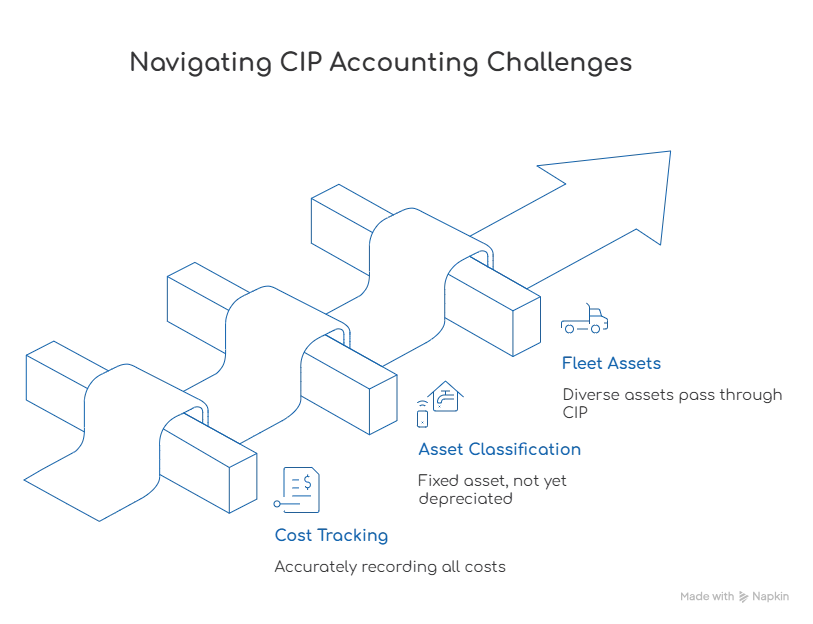
Once the asset is completed and put into service, the CIP balance transfers to the appropriate fixed asset account and depreciation begins.
Until that point, the full cost accumulates in CIP, and every dollar that belongs there but isn't recorded there distorts your financial statements.
Why the timing matters: Recording a partially-complete asset as a depreciable fixed asset before it's operational overstates your expenses and understates asset value. Recording it too late does the reverse.
Both create compliance exposure under GAAP and IFRS, and often require stronger controls through systems like fleet compliance software.
Why Fleet Businesses Are More Exposed Than They Realise
Most CIP guides assume a single construction project with a clear start, end, and contractor relationship. Fleet infrastructure projects rarely work that way.
A depot expansion might run for eight months, involve three contractors, consume vehicles and fuel from your existing fleet, require permits at different stages, and absorb overhead from your maintenance team.
The costs are real. They belong in CIP. But they're being logged across different systems, fuel logs, maintenance records, invoices, often without integration.
This is where tools like fleet reporting & data analysis become critical to unify cost visibility.
Three patterns that break CIP accuracy
1. Fleet vehicles and equipment aren't capitalised
When your own vehicles haul materials or your mechanics work on the build, those costs should hit CIP.
Instead, they get logged as routine operational costs inside fleet maintenance systems, and never make it to the project.
2. Fuel and consumables fall through the cracks
Fuel used on a construction project is a project cost, not a fleet operating cost.
But without proper tagging in fuel management systems, it gets absorbed into general fuel spend.
3. Capitalisation timing is inconsistent
Projects become operational in phases, but without clear definitions, teams transfer assets inconsistently.
What Costs Belong in CIP
The question isn't just what can be capitalised, it's what gets missed.
The gap is almost always internal costs, especially those tied to fleet activity.
For example, fuel should be tracked separately using fuel expense tracking, not buried in general expenses.
Download Our Free Fleet Management Resources Now!
Prevent costly breakdowns and maximize uptime with our free checklist.
Download
The Three-Step CIP Process
Step 1: Record all construction costs
Every expense must go into CIP.
Best practice: assign a project code and ensure all teams use it, including operations.
Step 2: Monitor costs during the project
Regular reviews prevent overruns.
Without structured tracking, even strong budgets fail. This is where fleet budget planning becomes essential.
Step 3: Transfer when operational
Transfer only when the asset is ready for use.
For phased projects, partial capitalization may be required.
Best Practices That Actually Work
Assign project codes early
Fixing errors later is expensive
Track fleet + project costs together
Fuel, labour, and vehicle usage must map to both
Define “operational” upfront
Avoid subjective decisions later
Reconcile monthly with operations + finance
Finance alone cannot catch fleet-side cost gaps
Document capitalization decisions
Audit protection depends on it
How Disconnected Systems Create Problems
The practical challenge for most fleet businesses isn't understanding the accounting rules; it's that the costs that belong in CIP are scattered across systems that don't talk to each other.
Fuel costs sit in a fuel management system. Labour hours are in a payroll or time-tracking tool. Equipment usage is in a fleet management platform. Project invoices are in accounts payable. Each system captures its piece of the picture. Nobody's job is to assemble those pieces under a single project cost view.
The result is a CIP account that's easier to under-populate than to fill accurately. An under-populated CIP account creates an understated asset and overstated expenses, both of which matter when you're being audited, seeking financing, or reporting to the board.
The integration question: Before your next CIP project, ask: Does our fleet management system support project or job code tagging on expenses? Can fuel entries, service costs, and vehicle usage be allocated to a project rather than just a vehicle? If the answer is no, you have a manual reconciliation problem that compounds with every project you run.
Fleet management software that tracks expenses at the vehicle level and supports cost categorisation makes CIP cost capture significantly more reliable. When fuel fill-ups, maintenance costs, and vehicle usage are already tracked per asset with full receipt documentation, allocating a subset of those costs to a CIP project becomes a reporting exercise rather than a data archaeology problem.
Common Mistakes
GAAP vs IFRS
Both GAAP and IFRS require CIP accounting for assets under construction. The differences are at the margin, mainly around borrowing costs and the treatment of certain overheads. For most fleet businesses, the practical obligations are the same:
Both require:
- Capitalising all relevant costs
- Including project-specific overhead
- Transferring when ready for use
- Starting depreciation at that point
The issue isn’t standards, it’s inconsistent execution.
Final Take
CIP accounting isn’t complicated.
But for fleet businesses, execution breaks because cost data lives in operations, not accounting.
Accurate CIP depends on:
- fuel tracking
- maintenance logs
- vehicle usage
- expense allocation
This is where fleet cost visibility becomes a competitive advantage.
Fleet management software that tracks fuel, maintenance, and vehicle costs at the asset level makes CIP accurate by default, not by effort.
Simply Fleet helps you capture, structure, and allocate these costs in real time.