




Why the Class 8 Pre-Buy Window is Closed and How to Pivot
Key Takeaways
- Fuel is 20-30% of total carrier operating costs, and the most controllable large cost line that most fleets are not controlling.
- Most fleet fuel programs track total spend. That number is almost useless without per-unit etrics: MPG, cost per mile, idle time percentage, fuel variance.
- Fuel variance is the most under-tracked KPI in fleet management. An estimated 14% of fleet fuel payments were lost to fraud or theft in 2024, most of it undetected.
- Driver behaviour accounts for up to 33% of MPG variance between identical vehicles on identical routes. This is the highest-ROI intervention, and it requires data, not lectures.
- The 2026 operating environment, geopolitical price volatility, regulatory uncertainty, and alternative fuel adoption, make internal efficiency metrics more important than ever. You cannot control the pump price. You can control how many gallons it takes to do the work.
Most fleet fuel guides start with a statement about fuel being your biggest cost. That is true. Most of them then provide a list of KPIs to track. That is also useful.
What they tend to skip is the part that actually changes outcomes: which metrics are actionable and which ones just describe the problem, where the real losses are hiding, and what the industry data says about what actually works versus what sounds like it should work.
I've spent time going through the research on this, NACFE's fleet fuel studies, ATRI's operational cost data, DOE's idling research, Motive's fraud analysis. The numbers are more specific, and in some cases more alarming, than most fleet content lets on. This guide tries to put them in context that a fleet manager can actually use.
Key data points from the research
- Fuel accounts for 20-30% of total carrier operating costs, rising to 28% in years of elevated diesel prices (ATRI)
- 14 fleets in NACFE's 2024 Fleet Fuel Study saved $512 million in 2023 by operating more efficiently than average, not by buying different trucks
- 55% of fleets reported reduced fuel costs after implementing telematics software (G2 Fleet Management Statistics)
- An estimated 14% of fleet fuel payments were lost to fraud or theft in 2024, rising to 19% at enterprise level (Motive Physical Economy Outlook 2024)
1. The 2026 operating environment: why internal metrics matter more than ever
Fleet operators entered 2026 navigating one of the more complex fuel environments in recent memory. Diesel averaged $3.21 per gallon in 2024, down 11% from $3.83 in 2023, relative stability on paper. But the five-year range has swung from $2.55 to $4.99. In 2022 alone, diesel jumped 53.7% year-over-year.
The geopolitical picture adds uncertainty on top of that volatility. According to WEX's Fleet Economics & Operations Outlook, conflict in the Middle East and instability in Venezuela have all added variables that fleet managers cannot model or predict.
The practical implication is straightforward: fuel price forecasting has never been less reliable. When external prices are unpredictable, the rational response is to maximise the value of every gallon purchased. That means rigorous tracking of the metrics you control, MPG, idle time, fuel variance, driver behaviour, not just the ones that reflect what the market is doing to you.
You cannot control what diesel costs at the pump. You can control how many gallons it takes to do the same amount of work. That is the entire premise of fleet fuel KPI management.
The regulatory environment: more complex, less certain
Emissions regulations add another dimension, and 2026 is an unusually uncertain year for compliance planning.
The EPA's greenhouse gas standards require automakers to reach 161 grams of CO2 per mile by model year 2026. NHTSA separately targets a fleet-wide average of 49 MPG by 2026. For heavy-duty fleets, joint EPA/NHTSA rules under the Heavy-Duty National Program cover combination tractors, heavy-duty pickup trucks and vans, and vocational vehicles.
📝SAMI'S NOTE: The coverage of fleet emissions regulation tends to present either the federal requirements or the California requirements as 'the standard.' For most mid-size fleet operators running across multiple states, the reality is more fragmented than either picture suggests. Check your operating footprint before assuming which rules apply.
2. The core fuel KPIs: what to track and why
Not all metrics are equally actionable. The following KPIs provide the most operational leverage, each targets a different loss point, and together they give a complete picture of where fuel spend is going and why.
KPI 1: Fuel efficiency (MPG or L/100km)
Formula: Miles driven divided by gallons consumed.
This is the foundational metric. Everything else contextualises it or explains it.
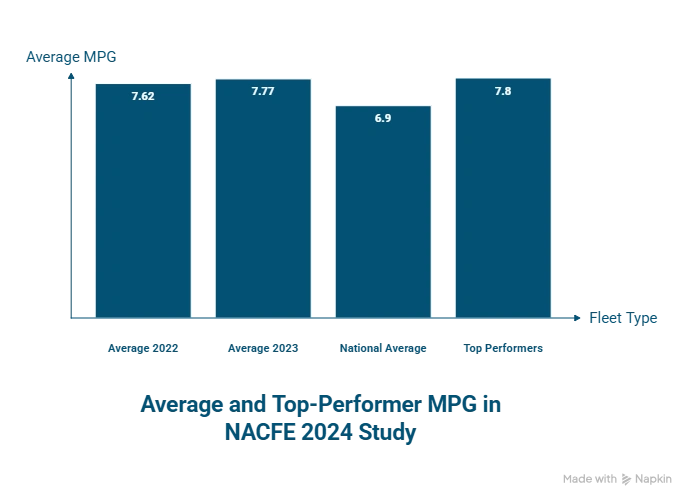
NACFE's 2024 Fleet Fuel Study found the average MPG of study fleets improved to 7.62 in 2022 and 7.77 in 2023. The national average for Class 8 trucks sits at around 6.9 MPG. Top performers in the study averaged 7.8+ MPG. That 0.9 MPG gap between average and top-performer translates to approximately $10,000 per truck per year at typical diesel prices (ATBS Research).
What drives MPG down: low tyre pressure (up to 10% efficiency reduction), clogged air filters (up to 10%), aggressive driving (15-30%), excessive speed (7-14% per 5 mph above 55 mph), and excessive idling.
📝SAMI'S NOTE: Track MPG at the individual vehicle level, not the fleet average. A fleet averaging 7.2 MPG might contain vehicles running at 5.5 MPG dragging the number down, vehicles that are either signalling a maintenance problem or a driver behaviour problem. Fleet averages mask the outliers that most need attention.
KPI 2: Fuel cost per mile
Formula: Total fuel cost divided by total miles driven.
This metric normalises for price volatility and distance variation. It is more useful than total fuel spend because it separates what the market is doing from what your operation is doing.
ATRI data shows large fleets achieved approximately $0.61 per mile in fuel costs in 2022, compared to $0.72 per mile for small fleets. That $0.11 gap reflects purchasing power, but it also reflects routing efficiency, driver behaviour management, and maintenance discipline, all things that smaller fleets can improve regardless of fleet size.
If MPG holds steady but fuel cost per mile rises, the issue is external price pressure, you're buying at a worse rate than before. If both rise together, you have an internal efficiency problem. The two metrics together tell you something that neither tells you alone.
KPI 3: Idle time percentage
Formula: Idle hours divided by total engine hours, multiplied by 100.
This is the metric most fleet managers underestimate until they see the numbers.
The U.S. Department of Energy's Argonne National Laboratory estimates more than 6 billion gallons of gasoline and diesel are wasted annually by idling vehicles across the United States. At a conservative $2 per gallon, that is more than $11 billion in wasted spend nationally each year.
For commercial fleets specifically: medium-duty trucks alone use approximately 2.5 billion gallons of fuel idling annually, about 6.7% of their total fuel consumption, per the Transportation Research Board. Long-haul heavy-duty trucks idling during required rest stops consume more than 685 million gallons per year, costing fleets over $2 billion annually.
At the individual vehicle level: a single heavy-duty truck idling 8 hours per day, 300 days per year, wastes approximately $6,000 in fuel annually for zero productive miles. For a fleet of 100 trucks where excessive idling averages just 2 hours per day, annual waste exceeds $1.5 million.
📝SAMI'S NOTE: The idling research also shows something less obvious: excessive idling accelerates engine wear in ways that amplify the cost beyond the wasted fuel. Argonne estimates idling adds the equivalent of 64,000 miles of engine wear for every 1,000 hours of idle time. The fleet manager who thinks of idling as only a fuel problem is undercounting the cost.
Compliance dimension: California fines vehicles for more than 5 minutes of idling, $250 for a first offence, $500 for a second, $1,000 for subsequent infractions. Dozens of other states and municipalities have similar rules. The DOE's IdleBox toolkit (afdc.energy.gov) provides free resources for fleet idle reduction programmes.
- Target: below 15% idle time for most commercial fleet applications (NACFE guidance)
- Red flag: above 25% idle time, this warrants immediate investigation and driver coaching
- Rule of thumb: every 10% of idle time results in approximately 1% decline in overall fuel economy
KPI 4: Fuel variance (purchased vs. consumed)
Formula: Total fuel purchased minus total fuel consumed per odometer or telematics data.
This is the most under-tracked KPI in fleet management. Most fleets never systematically compare purchased fuel against consumed fuel, which means theft and misuse go undetected for months or years.
The numbers from Motive's Physical Economy Outlook 2024 are worth sitting with: an estimated 14% of fleet fuel payments were lost to fraud or theft in 2024, rising to 19% at the enterprise level. Annual fraud losses across all sectors exceeded $16 billion in 2024, a 33% year-over-year increase.
NAFA estimates fuel theft can account for up to 6% of a fleet's total fuel cost. Industry figures suggest the average fleet experiences approximately 5 gallons of fraudulent fuel purchases per vehicle per month, for a 20-vehicle fleet, that is 1,200 gallons annually, worth approximately $4,300 at average diesel prices.
📝SAMI'S NOTE: The statistic that stood out most in the Motive research: 55% of fleet operators struggle to detect when they are experiencing fuel fraud. This is not a security gap, it is a data gap. Fleets that do not systematically reconcile purchased fuel against consumed fuel have no mechanism to detect variance, which is exactly what fraudulent behaviour exploits.
Common forms of fuel variance: card skimming, internal employee theft (using cards for personal vehicles), side fueling, mileage inflation, data entry errors, and mechanical leaks.
Target: less than 2% unexplained variance. Persistent variance above 5% requires a formal audit.
KPI 5: Fuel cost per revenue hour
Formula: Total fuel cost divided by total billable or productive hours.
For service fleets, construction equipment operators, and any operation where vehicles generate billable output by the hour rather than the mile, this metric connects fuel spending directly to productivity. Distance travelled is not the primary output measure for an excavator or a generator, fuel cost per productive hour is.
If fuel cost per revenue hour rises consistently, it signals either mechanical inefficiency, excessive idle time on job sites, or scheduling problems reducing productive utilisation. The metric tells you the symptom; the investigation finds the cause.
Download Our Free Fleet Maintenance Resources Now!
Prevent costly breakdowns and maximize uptime with our free checklist.
Download
KPI 6: Driver behaviour score
This is a composite metric covering harsh braking, harsh acceleration, and speeding events, normalised per mile or per hour to account for different route distances.
Driver behaviour is the single largest controllable factor in fleet fuel consumption, accounting for up to 33% of the variance in MPG between vehicles in the same fleet operating under similar conditions (Geotab 2025 fleet efficiency research).
The most fuel-impactful behaviours: harsh acceleration (can lower fuel economy by 10-40% in stop-and-go traffic, per Oak Ridge National Laboratory), speeding (at 75 mph versus 65 mph over 600 daily miles, a driver burns roughly 24 extra gallons, approximately $80 per day at average diesel prices), and harsh braking (every hard stop converts kinetic energy to heat rather than distance).
📝SAMI'S NOTE: Eco-driving training programmes have reported 5-30% reductions in annual fuel consumption through behaviour change alone, with zero capital investment required. The range is wide because programme quality varies enormously. The fleets achieving 30% reductions are not doing something dramatically different from the ones achieving 5%, they're sharing individual data with drivers and creating peer visibility. The data does the work.
3. The complete fuel KPI reference table
4. Supporting metrics: what drives the core KPIs
Fuel KPIs don't move in isolation. These supporting metrics provide the root cause context that the core KPIs signal but don't explain.
Preventive maintenance compliance
The relationship between maintenance and fuel efficiency is documented and specific. A 10% reduction in tyre pressure increases fuel consumption by approximately 1% and reduces tyre tread lifecycle by 15%. Clogged air filters reduce fuel efficiency by up to 10%. Worn oxygen sensors and faulty mass airflow sensors can reduce MPG by 25-40% in petrol vehicles.
Track the percentage of PM tasks completed on time versus overdue. A fleet at 95%+ PM compliance will consistently outperform one at 80%, all else being equal. A sudden MPG drop on a specific vehicle is almost always a maintenance signal. Fleet managers who treat their fuel KPI dashboard as a maintenance early-warning system catch problems before they become expensive.
Route efficiency
Poor routing increases fuel consumption in two ways: unnecessary miles, and stop-and-go conditions that reduce MPG. Route optimisation software can reduce fuel costs by 15-30%; AI-powered optimisation can reduce fuel bills by up to 20% (industry research).
Travel distance reduction of just 10% through route optimisation typically translates to 11% fuel consumption reduction. For a fleet spending $500,000 annually on fuel, a 10% route-efficiency improvement produces $55,000 in annual savings.
📝SAMI'S NOTE: The coverage of route optimisation tends to focus on sophisticated AI-powered tools. The less-covered finding is that most fleets have not exhausted basic route improvements first, looking at routes with high backtracking frequency, schedules that consistently hit rush-hour traffic, and multi-stop sequences that could be reordered for fuel efficiency. Start there before buying software.
Vehicle utilisation rate
Under-utilised vehicles still consume fuel in running costs, maintenance, and fixed overhead. A vehicle that sits idle three days a week but gets fuelled regularly introduces noise into your fuel consumption data. Track utilisation rate (active days divided by available days) alongside fuel KPIs to ensure you're comparing meaningful performance data rather than low-utilisation vehicles skewing your averages.
5. Industry benchmarks
These benchmarks are reference points, not universal targets. Your optimal MPG depends on vehicle specs, payload weights, terrain, and operational profile. Compare similar vehicles in similar conditions, comparing a loaded tanker to a cargo van tells you nothing.
6. Setting targets that actually create accountability
Generic targets produce no results. 'Improve fuel efficiency' is not a target, it is a preference.
The most effective fuel KPI targets are specific, measurable, time-bound, and tied to a plan. Before setting any target, you need a 30-60 day baseline period of data collected without major operational changes. This gives you a realistic starting point reflecting your current vehicle mix, driver behaviour, and route profile.
During the baseline period, you will almost certainly find that 20% of your vehicles or drivers account for 80% of your fuel inefficiency. The Pareto principle applies reliably in fleet fuel management. That finding should shape where you direct your first interventions.
Examples of well-formed targets:
- Reduce fleet-wide idle time from 20% to 12% within 90 days through driver coaching and telematics alerts
- Improve average MPG for the 10 lowest-performing delivery vehicles by 8% over two quarters through preventive maintenance and behaviour intervention
- Reduce fuel variance below 3% across all vehicles within 60 days through fuel card controls and monthly reconciliation
- Achieve 95% PM schedule compliance by Q2, measured against current 78% baseline
📝SAMI'S NOTE: Review fuel KPI targets quarterly, not annually. Fleet conditions change, vehicle turnover, seasonal routes, new drivers. A target that was appropriate in Q1 may need revision by Q3. Monthly monitoring with quarterly target reviews is the right cadence for most mid-size fleets.
7. From data to action
Data collection without action creates no value. The most common failure mode in fleet fuel management is not a lack of data; it is a lack of a structured process for moving from insight to intervention.
Driver coaching: the highest-ROI intervention
Multiple studies confirm that driver behaviour coaching based on objective data delivers the fastest and most cost-effective fuel savings of any fleet intervention. The critical distinction is specificity.
'You are idling too much' is not coaching. 'Your idle time last week was 28% versus the fleet average of 14%, and your estimated fuel waste was 22 gallons, here is what that cost, and here is what we're going to change' is coaching.
Effective coaching programmes: weekly or bi-weekly one-on-one review of individual data, peer benchmarking dashboards accessible to all drivers, recognition for top performers (not just penalties for poor performance), eco-driving training focused on specific high-impact behaviours, and a clear written fuel policy reviewed annually.
Maintenance-driven interventions
A sudden MPG drop on a specific vehicle is almost always a maintenance signal. Fleet managers who see a vehicle's fuel efficiency fall more than 5% below its historical baseline should schedule an inspection immediately, before the underlying issue becomes more expensive.
The most common maintenance issues that directly impact fuel efficiency: low tyre pressure, worn or mismatched tyres, clogged air filters, dirty fuel injectors, faulty oxygen sensors, wheel alignment issues, and failing emissions equipment (particularly diesel particulate filters and EGR systems).
Fuel purchasing strategy
Where and how you buy fuel affects your fuel cost per mile independent of how efficiently your vehicles run. Fleet operators using bulk fuel purchasing agreements, volume discounts through fuel card networks, or fuel buying cooperatives can achieve substantial per-gallon savings compared to pump retail price.
Modern fuel cards with advanced controls are one of the most cost-effective anti-fraud tools available. Per-card spending limits by day, time, and location; pump-only restrictions; real-time transaction alerts; EMV chip-and-PIN; and two-factor authentication at the pump (card plus PIN plus vehicle-specific prompt) all significantly reduce unauthorised transaction exposure.
8. Technology: what it enables and what it doesn't replace
Telematics
Manual fuel tracking, spreadsheets, paper logs, and driver-reported fill-ups, create errors, delays, and blind spots. It is nearly impossible to detect fuel theft through manual processes, and driver behaviour data simply doesn't exist without technology.
Modern telematics provides real-time data on fuel tank levels, fuel usage per trip, MPG, harsh driving events, speed compliance, idling time, and vehicle location. When integrated with fuel card transaction data, telematics enables the cross-referencing that makes fuel variance detection reliable.
55% of fleets reported reduced fuel costs after implementing telematics software (G2 Fleet Management Statistics). Fleets using comprehensive monitoring systems report 78% average theft reduction within the first year (fleet security research)
📝SAMI'S NOTE: Telematics is frequently positioned as a surveillance tool in fleet operations discussions. That framing creates adoption resistance that costs more in lost efficiency than it saves in goodwill. The more accurate framing, and the one that produces better outcomes, is that telematics is a coaching tool. The best fleet managers use it to have better, more specific conversations with drivers, not to catch them doing something wrong.
AI and predictive analytics
The adoption of fuel-efficiency technologies grew from 17% in 2003 to 42% in 2023 (NACFE). AI-powered analytics tools are becoming increasingly accessible to mid-size fleet operators who previously couldn't afford enterprise software.
9. Common mistakes in fleet fuel KPI programmes
Tracking only total fuel spend
Total fuel spend conflates price changes, volume changes, and efficiency changes into a single number you cannot act on without decomposing it first. It is the least actionable fuel metric available. Per-unit metrics, cost per mile, MPG, idle time percentage, separate what the market is doing from what your operation is doing.
Analysing fleet averages without individual vehicle data
Fleet averages are comfort metrics. They smooth over the outliers that most need attention. Always analyse at the individual vehicle and driver level. The fleet average tells you whether you're improving over time. The individual data tells you where to act.
Collecting data but not acting on it
Every KPI report should trigger a specific action protocol. Investing in telematics and reporting tools, then not following through with driver coaching, maintenance interventions, or route changes, produces no ROI and breeds cynicism. If you can't name the person responsible for acting on a specific metric, the metric is decorative.
Ignoring fuel variance
Fuel variance is the most under-tracked KPI in fleet management. Many fleet managers never compare purchased fuel against consumed fuel systematically, which means theft and misuse go undetected for months or years. A monthly reconciliation process, even a simple one, dramatically reduces fraud exposure.
Not connecting fuel KPIs to maintenance data
Fuel efficiency and vehicle health are deeply connected. A fleet that tracks fuel KPIs without connecting them to maintenance records misses the most important diagnostic signal those KPIs provide. An MPG drop is a maintenance alert. Treat it as one.
10. Trends to watch
Alternative fuels gaining ground
The fuel management picture is moving beyond diesel. According to the State of Sustainable Fleets 2025 report, 39% of surveyed fleets now use renewable diesel and 29% use biodiesel. Renewable diesel production grew 28% in the first half of 2024. Natural gas is also resurging: Class 8 natural gas tractor registrations surged nearly 50% year-over-year in 2024 to 2,317 units.

For fleet managers, this means fuel KPI frameworks need to expand, tracking cost per diesel-equivalent gallon, carbon intensity scores, and fuel-type efficiency comparisons alongside traditional metrics.
EV transition and the new KPI landscape
331 U.S. fleets were operating electric medium/heavy-duty trucks in 2024, with 127 added in that year alone. New KPIs emerge alongside the vehicles: cost per kWh, charging efficiency, range utilisation, and total cost of ownership versus diesel equivalents.
📝SAMI'S NOTE: The North American Electric Reliability Corporation issued a January 2026 report warning that large sections of the U.S. grid will be unstable by 2030 due to rising power demand. For fleets planning EV transitions, grid reliability is a new operational risk factor that doesn't appear in most EV adoption guidance. It should. A charging infrastructure investment that depends on grid stability in regions NERC has flagged as at risk is a plan that needs a contingency.
AI-powered predictive fuel management
The next frontier is not reporting what happened, it is predicting what will happen. AI systems that analyse telematics data, maintenance records, weather, traffic, and fuel price trends can now generate recommendations that optimise fuel KPIs before problems occur rather than after.
The fleets that will benefit most from these tools are the ones building clean data infrastructure now. The AI is only as good as the data it runs on, and a fleet with three years of clean, consistent fuel KPI data will extract far more value from predictive tools than one starting from scratch.
11. Action checklist: implementing a fuel KPI programme
Week 1-2: Baseline and setup
- Pull 60 days of historical fuel transaction data and clean it for analysis
- Calculate current baseline for all 8 core KPIs in the reference table
- Identify the top 10% and bottom 10% performers by MPG and idle time
- Audit current fuel card controls: limits, PIN requirements, location restrictions
- Verify telematics data is being captured at minimum for MPG, idle time, and harsh events
Month 1: First interventions
- Schedule one-on-one coaching with the 5 lowest-MPG drivers using their actual data
- Implement a formal idle reduction policy with specific thresholds and tiered alerts
- Run your first fuel variance analysis, compare purchased fuel to consumed fuel per vehicle
- Check tyre pressure across the fleet and establish a weekly tyre check schedule
- Review PM schedule compliance rate and identify overdue maintenance items
Month 2-3: Systematic optimisation
- Analyse the 5 highest-mileage routes for optimisation opportunities
- Set SMART targets for each core KPI with 90-day and 180-day milestones
- Create a driver leaderboard with MPG, idle time, and driving behaviour scores, shared with drivers
- Implement monthly fuel variance reconciliation as a standing administrative process
- Brief senior management on current fuel KPI performance and projected savings from interventions
Ongoing: Continuous improvement
- Review individual vehicle KPI data weekly; fleet aggregate data monthly
- Conduct quarterly route analysis and adjust routes based on performance data
- Update KPI targets quarterly based on baseline improvements achieved
- Benchmark annual technology adoption rate against NACFE industry data
- Review fuel card provider security features annually
Conclusion
The $512 million that NACFE's 14 study fleets saved in 2023 compared to average operators is worth returning to at the end of this guide, because it answers the most common objection to rigorous fuel KPI management: that it is too much work for the return.
Those savings did not come from newer trucks or lower pump prices. They came from systematic tracking, consistent driver coaching, and disciplined maintenance, all driven by the right metrics measured consistently and acted upon. The data infrastructure required to do this is accessible to any fleet with a telematics system and a fuel card programme.
The fleets that will outperform over the next decade are not necessarily the ones with the newest equipment. They are the ones with the cleanest data and the discipline to act on it. Start with the baseline. The rest follows from there.
Key resources
- U.S. Energy Information Administration (EIA) — Weekly Diesel Price Tracker: eia.gov/dnav/pet/pet_pri_gnd_a_epd2d_pte_dpgal_w.htm
- U.S. DOE Alternative Fuels Data Center — Idle Reduction: afdc.energy.gov/conserve/idle-reduction-basics
- U.S. DOE — Idle Reduction Benefits (Argonne National Laboratory): afdc.energy.gov/conserve/idle-reduction-benefits
- EPA — Greenhouse Gas Emissions Standards: epa.gov/regulations-emissions-vehicles-and-engines
- NACFE — Fleet Fuel Study (2024): nacfe.org/news/nacfe-releases-latest-fleet-fuel-study
- ATRI — Operational Costs of Trucking: atri-online.org
- State of Sustainable Fleets Report: stateofsustainablefleets.com
- WEX — Fleet Economics & Operations Outlook: wexinc.com/resources/blog/fleet-economics-operations-outlook
All statistics cited reference publicly available research from the sources listed above. Fuel prices and regulatory standards change frequently; verify current data from official government and industry sources.
Track the metrics that move the number, not just the ones that describe it.
Simply Fleet tracks fuel consumption, idle time, and maintenance compliance against individual vehicles, not just fleet totals. When a vehicle's MPG drops, it flags against the maintenance record. When fuel variance appears, it shows up against the specific card and vehicle. The data that makes fuel KPI management actionable, in one place.