






Preventive Maintenance Checklist for Excavators: What to Check and When
Key Takeaways
- Professional fuel injector cleaning typically costs $150–$200 per vehicle in the US.
- DIY fuel additives run $10–$25 but are preventive only; they won't fix heavy deposits.
- Cleaning improves fuel efficiency, engine performance, and reduces long-term maintenance spend.
- It should be scheduled on actual data, symptoms or fuel consumption trends, not blindly at fixed intervals.
- Without fleet management software tracking fuel usage per vehicle, you'll either over-maintain or miss the problem entirely.
Fuel injectors are responsible for delivering a precise spray of fuel into the engine for combustion. When they clog, and they will, over time, fuel efficiency drops, power falls off, and combustion becomes uneven. For a single vehicle, that's an inconvenience. For a fleet of 20, 50, or 200 vehicles, it's a cost drain that compounds silently until someone actually looks at the data.
This guide covers the costs, the methods, and, more usefully, how to build the trigger logic for scheduling injector cleaning so you're not doing it too early or too late.
What Is Fuel Injector Cleaning and Why Does It Matter for Fleets?
Fuel injectors deliver the right amount of fuel in a fine spray pattern timed to each engine cycle. Carbon deposits and fuel residue build up on the injector nozzle over time, changing that spray pattern. The result: incomplete combustion, reduced power, and worsening fuel economy that shows up gradually in your consumption data, if you're tracking it.
For individual vehicles, a slightly clogged injector might mean a rough idle or a 2–3% MPG drop. For a fleet, that same 2–3% multiplied across vehicles and multiplied by miles becomes a meaningful budget line. It's exactly the kind of hidden maintenance cost that doesn't show up on a work order until the damage is already done.
📌The step that's missing from almost every maintenance guide on this topic: tracking fuel consumption per vehicle, not total fleet consumption. Fleet-wide averages hide the outlier that's running 15% above baseline. That outlier is the vehicle telling you something is wrong.
How Much Does It Cost to Clean Fuel Injectors?
The cost range is wide because the methods are genuinely different, not just in price but in what they fix. Here's the full picture, with fleet context added to the standard breakdown. For a detailed view of how this fits into your overall fleet maintenance costs, that guide is worth reading alongside this one.
In most real-world fleet scenarios, the working number is $150–$200 per vehicle for a professional cleaning service. At 50 vehicles, that's a $7,500–$10,000 maintenance event, which is why getting the scheduling logic right matters far more than the per-vehicle price. Tracking total cost of ownership per vehicle makes it straightforward to calculate the ROI of preventive cleaning versus waiting for a symptom.
What Factors Affect Fuel Injector Cleaning Cost?
The variation in cost is not random. These are the practical factors that determine what your fleet will actually spend:
Engine Type: Petrol vs Diesel
Petrol injectors are simpler and generally cheaper to clean. Diesel injectors , particularly common rail systems , are more complex, often require removal, and need more precise cleaning methods. If your fleet runs diesel-heavy, budget for the upper end of the price ranges above. See also: diesel fleet maintenance checklist for the full service scope beyond injectors.
Level of Contamination
Light deposits respond to additives or basic flushing. Heavy clogging from neglected intervals or poor fuel quality requires ultrasonic cleaning, which is both more expensive and takes vehicles out of service longer. This is the argument for preventive scheduling: preventive maintenance costs a fraction of what reactive repair costs once damage is done.
Cleaning Method
Additives are the cheapest but limited. Machine cleaning balances cost and effectiveness for moderate buildup. Ultrasonic cleaning is the most thorough but comes with a higher cost and longer turnaround. Choosing the right method for a given vehicle's condition isn't guesswork; it comes from having service history to reference.
Labor and Service Provider
Local garages, authorized service centers, and dedicated fleet service providers all price differently. For fleets, the more useful variable is not the hourly rate but the work order tracking and documentation that follows the service, which feeds back into your next scheduling decision.
Types of Fuel Injector Cleaning Methods
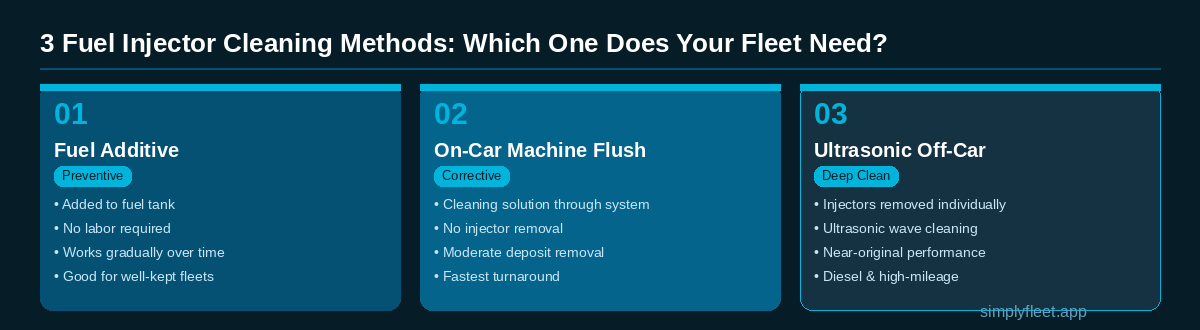
Most guides stop at listing the three methods. The step that's missing from almost every one of them: matching method to vehicle condition, not just price. Here's how to think about that decision:
Fuel Additives: Preventive Maintenance
Liquid cleaners added directly to the fuel tank. They work gradually as the vehicle operates, removing light deposits over several hundred miles. The right use case is prevention, not cure: well-maintained fleet vehicles on a regular preventive maintenance schedule, where the goal is to slow deposit buildup rather than reverse it. Budget for $10–$25 per vehicle and track whether consumption trends actually improve after use.
On-Car Cleaning (Machine Flush): Corrective
A cleaning solution runs through the fuel system using specialized equipment attached to the fuel rail. No injector removal required, which keeps downtime short. Effective for moderate deposits , typically the right choice when a vehicle is showing early symptoms but hasn't been neglected. Most fleet service intervals fall here.
Download Our Free Fleet Maintenance Resources Now!
Prevent costly breakdowns and maximize uptime with our free checklist.
Download
Off-Car Ultrasonic Cleaning, Deep Clean
Injectors are removed, individually cleaned using ultrasonic waves in a cleaning solution, flow-tested, and reinstalled. This removes stubborn carbon deposits that on-car methods can't reach and restores near-original spray patterns. The right choice for high-mileage vehicles, diesel fleets, or vehicles where on-car cleaning has already been tried without result. Cost and downtime are higher, worth it when the alternative is injector replacement.
When Should Fuel Injectors Be Cleaned?
Injector cleaning is not something that should be done at fixed intervals regardless of condition, that's exactly how fleets over-maintain without actually solving the problems that cost them money. The trigger should come from either data or symptoms.
Data-Driven Triggers (Preferred)
- A vehicle's fuel consumption rises above its own baseline by more than 5–8% over several weeks
- Fleet-wide fuel efficiency tracking identifies one or more outlier vehicles that consume disproportionately more than comparable units
- A maintenance log shows cleaning hasn't been done in 15,000–30,000 miles on a high-utilization vehicle
- Upcoming emission compliance check for vehicles where combustion efficiency affects results
Symptom-Based Triggers
When data tracking isn't yet in place, these are the field signals that warrant inspection. They appear earlier in the vehicle maintenance schedule than most teams expect:
- Reduced fuel efficiency noticed by drivers or flagged in fill-up records
- Engine misfires or hesitation during acceleration, often misdiagnosed as ignition issues
- Rough idle, particularly in older or high-mileage diesel vehicles
- Noticeable drop in power under load, especially in delivery or service vehicles that are frequently loaded
- Failed or borderline emissions results
Recommended Cleaning Interval
Most manufacturers and service guidance suggests cleaning every 15,000 to 30,000 miles (approximately 24,000 to 48,000 km) under normal conditions. But for fleets, the relevant trigger is often consumption data, not mileage, especially for vehicles running in stop-start urban conditions, which accelerates deposit buildup relative to highway miles. Air filter replacement intervals follow similar logic and should be reviewed at the same time.
Is Fuel Injector Cleaning Worth It for Fleets?

For a single car, injector cleaning is a minor maintenance line. For a fleet, the math changes entirely because every efficiency gain or loss multiplies across every vehicle and every mile driven. Here's the actual business case:
- Improved fuel efficiency. Even a 2% improvement in fuel economy across 50 vehicles driving 40,000 miles per year translates to meaningful savings. At $4/gallon and 15 MPG average, that's roughly $10,700+ per year saved fleet-wide. See: how to lower your fleet fuel cost for a fuller calculation.
- Extended engine life. Clean injectors reduce combustion strain on engine components. This contributes directly to maximizing vehicle lifespan, delaying the repair-vs-replace decision on high-mileage vehicles.
- Reduced maintenance costs. Preventive cleaning at $150–$200 avoids injector replacement at $300–$900+ per injector. This is the central argument for treating injector cleaning as preventive maintenance rather than reactive repair.
Lower emissions. Efficient combustion produces cleaner exhaust. For fleets subject to emissions compliance, increasingly common across commercial operators, clean injectors reduce compliance risk.
The data on reactive vs preventive maintenance isn't ambiguous. Fleets that run reactive maintenance spend more, not less, than fleets with structured programs. The injector cleaning decision is a small, practical example of the same principle at work.
When Cleaning Is Not Enough: Signs of Actual Damage
There are situations where cleaning alone won't resolve the problem, and continuing to clean rather than replace wastes time and money. Knowing the difference is part of the increasing trend of maintenance costs that fleet managers face as vehicle fleets age.
Signs the Injector Needs Replacement, Not Cleaning
- Persistent misfires or rough running after two rounds of professional cleaning
- Fuel leaks from the injector body, o-rings, or fuel rail connection
- Electrical fault codes specific to injector driver circuits (not just fuel trim codes)
- Flow test results showing injector output more than 10–15% outside spec, a dead giveaway on off-car ultrasonic testing
Replacement Costs (For Planning Purposes)
Injector replacement runs $300–$900+ per injector depending on vehicle type, with diesel common rail injectors often exceeding this. Full set replacement on a diesel engine can easily reach $2,000–$5,000+ in parts and labor. This is why the cost of delaying maintenance compounds so quickly: a $150–$200 cleaning at the right point becomes a $1,000+ repair if the symptom is ignored for two more service cycles.
Tracking spend by vehicle asset over time makes it straightforward to see when a vehicle's cumulative repair costs are approaching the replacement threshold. Without that data, the decision is guesswork.
Common Mistakes Fleet Managers Should Avoid
Most guides cover what to do. Here's what the teams that get this wrong actually do, drawn from the patterns that show up most in fleet operations:
- Cleaning too frequently without data justification. Not every vehicle in a fleet needs cleaning at the same time or at the same interval. Blanket maintenance scheduling wastes spend. Data-driven triggers are more cost-efficient.
- Ignoring early consumption signals. The vehicle that's running 10% above its baseline fuel consumption is showing you a problem. Without per-vehicle fuel tracking, that signal disappears into fleet-wide averages.
- Relying only on additives for a vehicle showing symptoms. Additives are preventive, not curative. Using them on a vehicle with active symptoms is like applying tire dressing to a flat tire. The underlying deposit problem needs professional cleaning.
- No maintenance log for service history. Without knowing when the last cleaning was done and what condition the injectors were in, the next service decision is pure guesswork. Maintaining a vehicle maintenance log, even a basic one, changes this.
- Treating injector cleaning as isolated from the fuel system. Injector condition is connected to fuel quality, filter condition, and air filter replacement schedules. Cleaning injectors without addressing upstream issues means the deposits return faster.
How Fleet Management Software Optimizes Injector Maintenance
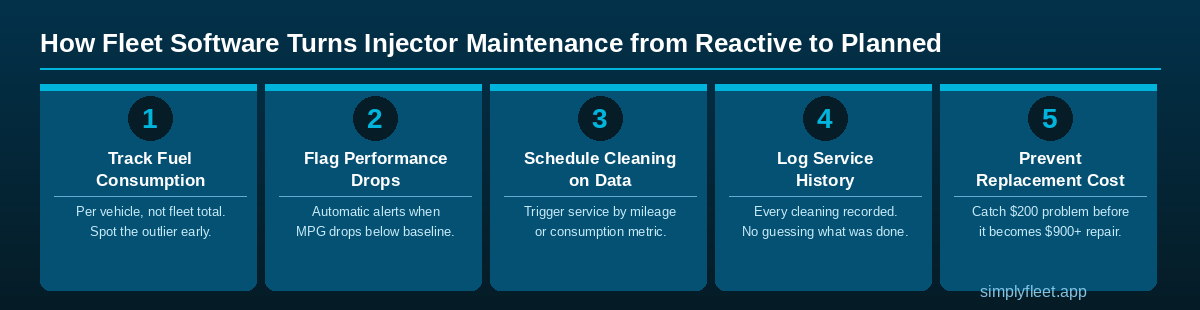
Managing injector cleaning manually across 20, 50, or 200 vehicles is where the process breaks down. The data exists, in fill-up receipts, driver reports, and service records, but without a system to connect it, you're back to guesswork. This is where fleet maintenance software closes the gap between having data and actually using it.
When I was researching this, the approach that most guides missed entirely was using fuel consumption trends per vehicle as the primary trigger for injector maintenance, rather than mileage. Here's what a proper software-backed process looks like:
- Track fuel fill-ups per vehicle. Not total fleet spend, per vehicle, so the 15%-above-baseline outlier becomes visible immediately. Fleet fuel management software makes this automatic.
- Set consumption-based alerts. When a vehicle's rolling average fuel consumption rises beyond a defined threshold, it triggers a service flag, before a driver complaint, before a breakdown.
- Log every cleaning with condition notes. Service history attached to the vehicle, not to a paper binder or a spreadsheet that leaves with the technician. Maintenance log software makes this searchable across the fleet.
- Schedule proactively, not reactively. Preventive maintenance scheduling can trigger an injector check at the right mileage interval for each vehicle type, not a one-size-fits-all calendar reminder.
- Connect to broader cost visibility. When injector maintenance is tracked alongside other service records, fleet data analysis can show which vehicles cost the most to run, and whether fuel inefficiency is the primary driver.
The most common onboarding question we hear from fleet managers isn't 'how do I set up reminders', it's 'how do I get my drivers to actually update mileage.' That's the real barrier. Once mileage data flows consistently, every consumption-based alert and service trigger follows automatically.
Final Thoughts
Fuel injector cleaning is not an expensive service. Done at the right time and on the right vehicle, it costs $150–$200 and pays back several times over in fuel savings, extended engine life, and avoided repair costs. Done blindly, too frequently, or too late, it's either waste or damage that has already compounded.
The gap between those two outcomes is almost entirely a data problem. Fleets that track fuel consumption per vehicle, maintain service history, and use consumption trends as maintenance triggers will schedule injector cleaning exactly when it's needed, and skip it when it isn't.
If you're managing a fleet between 20 and 200 vehicles, Simply Fleet tracks fuel usage per vehicle, flags consumption outliers, and connects service history to scheduling, so injector cleaning (and every other preventive maintenance decision) comes from data, not guesswork. Not sure whether the investment makes sense for your fleet size? The fleet software ROI calculator gives you a quick answer.