





Construction Equipment Downtime Cost: How to Calculate It (and Cut It)
Key Takeaways
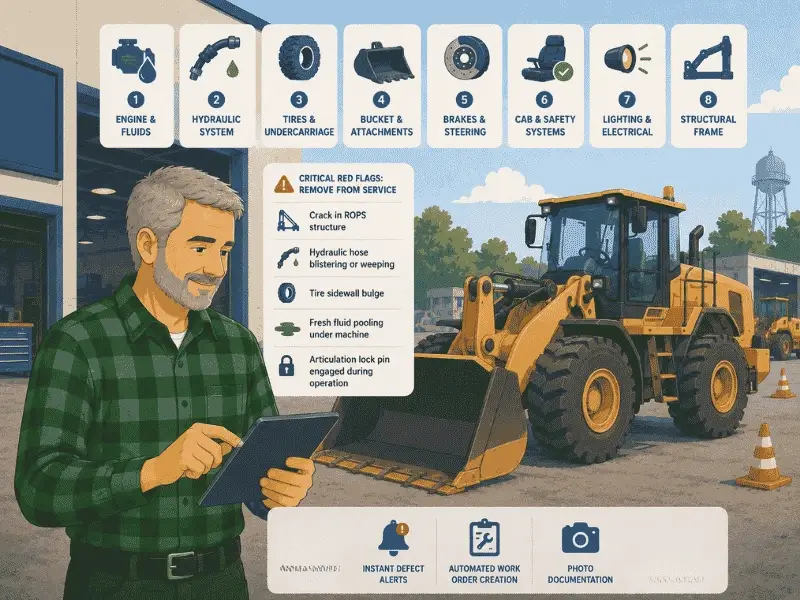
- A wheel loader daily inspection checklist must cover 8 zones: engine and fluids, hydraulic system, tires and undercarriage, bucket and attachments, brakes and steering, cab and safety systems, lighting and electrical, and structural frame. Complete the inspection every shift before the machine moves.
- Critical red flags that mandate immediate removal from service include any crack in the ROPS structure, hydraulic hose blistering or weeping, a tire sidewall bulge, any fresh fluid pooling under the machine, and the articulation lock pin being engaged during operation.
- OSHA 29 CFR 1926.600 and MSHA 30 CFR Part 56 both require pre-shift inspections to be documented and retained. Paper records are legally valid but operationally fragile because they cannot be audited in real time or trigger automated maintenance workflows.
- The daily pre-shift inspection does not replace 250-hour, 500-hour, or annual PM intervals. It catches acute failures such as punctures, hose abrasion, and fluid loss that scheduled maintenance cannot predict.
- Paper checklists fail due to pencil-whipping, lost records, no real-time defect escalation, no trend visibility, no accountability chain, and an inability to automatically trigger work orders.
- Simply Fleet digitizes the entire wheel loader pre-shift inspection process with photo documentation and work order creation, eliminating common paper-based inspection failures.
What Should Be Included in a Wheel Loader Daily Inspection?
A wheel loader is one of the most mechanically complex pieces of equipment on any construction, mining, or waste-management site. A missed daily check is not a paperwork inconvenience; it is a direct path to catastrophic drivetrain failure, hydraulic blowout, or a rollover incident. OSHA 29 CFR 1926.600 and most OEM manuals from manufacturers such as Caterpillar, Komatsu, and Volvo explicitly require pre-shift operator inspections before any wheel loader enters service.
A compliant, comprehensive wheel loader daily inspection checklist should address every system that can cause an operational shutdown or a safety incident within a single shift. That means the checklist must go far beyond a tire kick and a fuel gauge glance. The eight inspection zones below are the industry-recognized standard.
Walkaround & Visual Inspection Points
The walkaround inspection is the first line of defense and must be completed before the operator enters the cab. The operator should move systematically around the entire machine, front-to-back and ground-to-top, using the following sequence:
- Frame and chassis welds: Inspect for cracks, bends, or stress fractures, particularly at the articulation joint. Articulation joint failure is a leading cause of wheel loader rollovers on grade.
- Tires: Check all four tires for cuts, bulges, embedded objects, and inflation pressure. Compare measured PSI against the OEM's cold-inflation specification (typically 55–80 PSI for standard earthmoving tires depending on size). Uneven wear patterns indicate alignment or loading problems that must be escalated.
- Bucket and attachments: Inspect the bucket cutting edge for excessive wear, cracking, or missing ground-engaging tools (GET). Verify that all attachment pins and retaining hardware are fully seated and locked. A loose pin can allow a bucket to detach under load.
- Lift arms and linkage: Check for cracks at the boom-to-frame weld points and at bell crank connections. Inspect all visible hydraulic hose runs for abrasion, kinking, or chafing against metal surfaces.
- Cooling system: Verify that the radiator core is clean and free of debris. A blocked radiator in high-ambient-temperature environments can cause thermal shutdown within two hours of operation.
- Ground under the machine: Before any fluid checks, look at the ground directly under the engine, hydraulic reservoir, axles, and differential housings. Any fresh pooling of fluid, oil, coolant, hydraulic fluid, or DEF, is a red flag that must halt operation.
.webp)
Engine Compartment & Fluid Level Checks
Engine fluid checks must be performed with the machine on level ground and the engine cold (minimum 10 minutes after shutdown) for accurate readings. Fluid levels checked while the machine is still hot will produce falsely elevated readings on the dipstick.
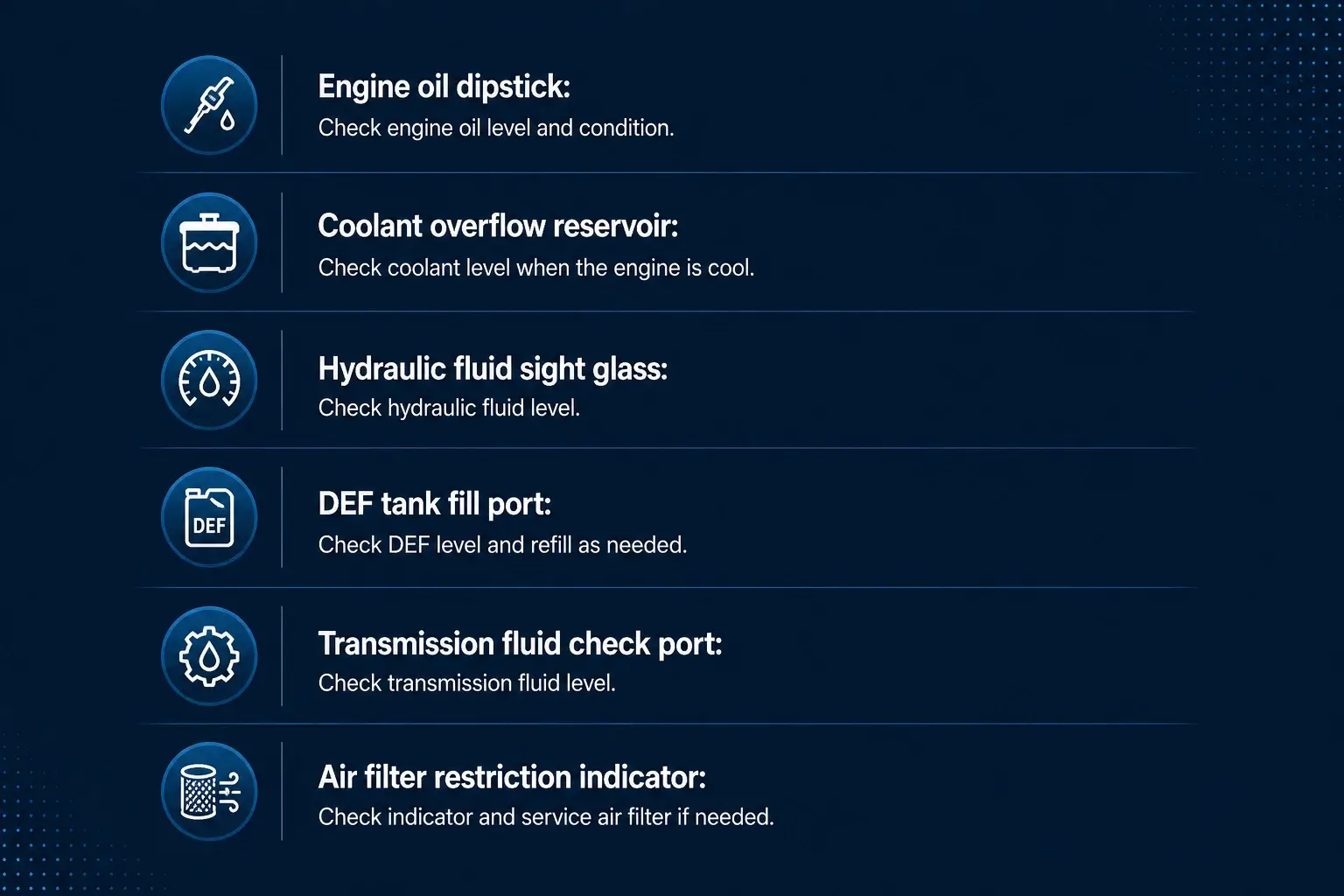
- Engine oil: Pull the dipstick, wipe clean, re-insert fully, and withdraw. The oil film must fall between the MIN and MAX marks. Check color and viscosity, milky or frothy oil indicates coolant intrusion (head gasket failure). Excessively dark and gritty oil suggests a delayed oil change interval.
- Coolant level: Check the overflow reservoir and the radiator cap (on a cold engine only). Coolant should be at the FULL mark. Inspect color, depleted DCA (Diesel Coolant Additive) causes pitting corrosion inside the engine block.
- Hydraulic fluid: Locate the hydraulic reservoir sight glass or dipstick. Fluid must be within the operating band. Hydraulic fluid that appears dark, cloudy, or has a burnt smell must be sampled and sent for oil analysis before the machine returns to service.
- Transmission fluid: Follow the OEM-specified check procedure (hot idle or cold, depending on manufacturer). Low transmission fluid produces erratic gear shifting and accelerates clutch pack wear.
- DEF (Diesel Exhaust Fluid): Tier 4 Final engines require DEF for SCR (Selective Catalytic Reduction). A low DEF level will trigger a power derate, reducing the machine to roughly 25% of rated power within the same shift.
- Fuel level: Confirm sufficient fuel for the planned shift. Record the fuel level in the inspection log so abnormal consumption between shifts can be tracked, unexpected fuel loss is a strong indicator of a leak or unauthorized use.
- Air filter restriction indicator: Most wheel loaders have a visual restriction indicator (red/yellow service band) on the air filter housing. A restricted air filter causes black smoke and reduces power output before any dash warning light activates.
- Drive belts and hose connections: Inspect all accessible belts for fraying, cracking, or glazing. Check coolant hose clamps and radiator connections for seepage.
Cabin & Safety Systems Verification
The cab inspection confirms that every safety system designed to protect the operator is fully functional before the machine moves. This step is non-negotiable and must be documented. An operator who skips this check and later experiences a brake failure or ROPS failure has no documented defense, and neither does the fleet manager.
- ROPS/FOPS integrity: Visually inspect the Roll-Over Protective Structure (ROPS) and Falling Object Protective Structure (FOPS) for cracks, unauthorized welds, or impact damage. Any modification or visible damage to the ROPS structure voids its certification and requires immediate removal from service.
- Seat belt condition: Check the webbing for cuts or fraying. Test the latch, it must lock positively and release cleanly. A worn or jammed seat belt is an OSHA-citable violation.
- Mirrors and cameras: Confirm all mirrors are clean, properly adjusted, and unobstructed. If the wheel loader is equipped with a rear-view or surround-view camera system, verify the display is functional before entering traffic areas.
- Horn and backup alarm: Test both. A non-functional backup alarm on a wheel loader operating near pedestrians is a serious safety exposure under OSHA 29 CFR 1926.602.
- Service and parking brakes: Apply the parking brake and attempt to drive the machine, it must not move. Then test service brakes at low speed in a clear area. Sponginess or pull to one side requires immediate maintenance intervention.
- Steering: With the engine running, check for excessive play (more than 1–2 inches of free movement at the rim) and confirm the articulation lock pin is removed and stowed before operating.
- All cab controls and instrumentation: Verify that all dash warning lights illuminate and extinguish correctly at startup. Confirm hydraulic control levers move through their full range without binding. Check the EMO (Emergency Machine Off) switch is accessible and functional.
- Fire extinguisher: Confirm the extinguisher is present, in its mount, fully charged, and within its inspection date.
- Lighting: Test headlights, work lights, strobe/beacon, and brake lights. Wheel loaders operating in low-visibility conditions or near roadways must have fully functional lighting, a burned-out work light in a night-shift quarry is an immediate safety violation.
Wheel Loader Daily Inspection Checklist
The table below is the complete, structured data version of the wheel loader daily inspection checklist. It is organized by inspection zone and includes the specific component to check, what the operator must verify, and the critical failure red flag that mandates removing the machine from service immediately.
Download Your Free Fleet Inspection Checklists Now!
Prevent costly breakdowns and maximize uptime with our free checklist.
Download
Why Inspection Intervals Matter: Daily vs. 250-Hour vs. 500-Hour Checks
The daily pre-shift inspection is one layer of a tiered maintenance strategy. Fleet managers who conflate daily inspections with scheduled PM intervals create dangerous gaps. Here is the distinction:
- Daily (Every Shift): Operator-executed pre-use inspection. Covers fluids, tire pressure, safety devices, and visual defects. Purpose: catch acute failures that developed since the last shift.
- 250-Hour Service: Technician-executed. Engine oil and filter change, hydraulic filter inspection, greasing of all pins and bushings to OEM torque spec. Purpose: prevent accelerated wear during the highest-frequency component service window.
- 500-Hour Service: Technician-executed. Transmission fluid and filter change, differential oil checks, coolant DCA additive top-up, air filter replacement, full hydraulic system pressure testing. Purpose: address medium-lifecycle component health before failures occur.
- Annual / 2,000-Hour Service: Full drivetrain inspection, hydraulic oil flush and analysis, structural weld inspection by qualified inspector, tire-to-rim inspection. Purpose: assess long-lifecycle structural and major component health.
The daily inspection exists to catch failures that the 250-hour service interval could not predict, a hose abraded by a loose bracket, a tire punctured on the last shift's job site, a missing GET tooth. No PM schedule replaces the pre-shift eye.
Industry Standards and Regulatory References
The wheel loader daily inspection requirements described in this checklist are aligned with, and validated by, the following authoritative industry and regulatory sources:
⚠ Regulatory Note for Fleet Managers: OSHA and MSHA both require that pre-shift inspection records be retained and available for inspection upon request. A paper log stored in a truck cab or job site trailer does not constitute an accessible, auditable record. Digital inspection records stored in a cloud-based platform such as Simply Fleet are retrievable within seconds from any device, a critical advantage during a regulatory audit or incident investigation.
Why Paper-Based Wheel Loader Checklists Fail Fleet Managers
Paper inspection forms are not a compliance solution, they are a compliance liability. The failure modes of paper-based wheel loader inspection programs are well-documented in fleet management literature and confirmed by fleet managers who have made the switch to digital systems:
- Pencil-whipping: Without a time-stamped submission there is no way to verify that an operator actually performed the inspection rather than checking boxes from the cab. Studies across heavy equipment fleets consistently show that 30–50% of paper pre-shift inspections are completed without the operator leaving the cab.
- Lost and damaged records: A paper inspection form that spends a shift in a muddy cab has a short life. Records soaked, torn, or blown out of an open door window are gone permanently. The inspection never happened, legally speaking.
- No real-time defect escalation: When an operator marks "hydraulic hose weeping" on a paper form, that defect report travels at the speed of paper, arriving in the maintenance office hours or days later. The machine continues to operate until the form is reviewed. A hydraulic hose that is weeping today is a burst hose tomorrow.
- No trend visibility: A fleet of 12 wheel loaders generating 12 paper forms per shift produces 3,000+ forms per year. No fleet manager manually analyzes 3,000 forms to identify that Unit 07's hydraulic oil consumption is trending upward, indicating a failing seal. The data exists but is permanently inaccessible.
- No accountability chain: Paper forms are anonymous unless manually signed. When an incident investigator asks "who inspected this machine on the morning of the incident and what did they find?", a pile of unsigned paper forms provides no answer.
- Cannot integrate with PM scheduling: Paper inspection results cannot trigger a work order. A defect caught on a paper form requires a human to read it, enter it into a maintenance system, and create a work order, a process that routinely takes 24–72 hours and is skipped under workload pressure.