



A Practical Guide to Preventing OOS Violations and Maintenance Failures
Key Takeaways
- Track your OOS rate to establish a baseline and identify maintenance weaknesses.
- Prioritize brake maintenance, since brake systems accounted for 39.1% of vehicle OOS violations in the 2026 CVSA Roadcheck data cited in the article.
- Standardize pre-trip inspections so drivers consistently check brakes, tires, wheel seals, lights, and other high-risk components.
- Move from reactive to preventive maintenance with scheduled service and automated maintenance alerts.
- Connect drivers and technicians by turning DVIR defects into timely maintenance action.
- Use DataQs to challenge violations that were issued in error or later dismissed.
- Use fleet maintenance data and AI Insights to surface recurring mechanical issues before they result in roadside failures.
Out-of-Service (OOS) violations and mechanical breakdowns are two of the costliest disruptions a fleet can face. When the Federal Motor Carrier Safety Administration (FMCSA) or a Commercial Vehicle Safety Alliance (CVSA) inspector places a vehicle out of service, the trip ends immediately on the spot.
The stakes have never been higher. Data from the 2026 CVSA International Roadcheck reveals a harsh reality for fleets: a staggering 19.0% of all vehicles inspected were placed out of service. Even more alarming, brake systems accounted for 39.1% of all vehicle OOS violations.
Beyond the immediate towing and emergency repair bills, these violations directly damage your Compliance, Safety, Accountability (CSA) scores, drive up insurance premiums, and ruin shipping schedules. Fortunately, most maintenance failures and OOS violations are completely preventable. This practical guide outlines how to build a bulletproof maintenance culture to protect your bottom line
1. Master the Math: Understand Your OOS Rate
To fix a problem, you must first measure it. Your fleet’s OOS rate is calculated by dividing the number of inspections resulting in an OOS violation by your total number of inspections:
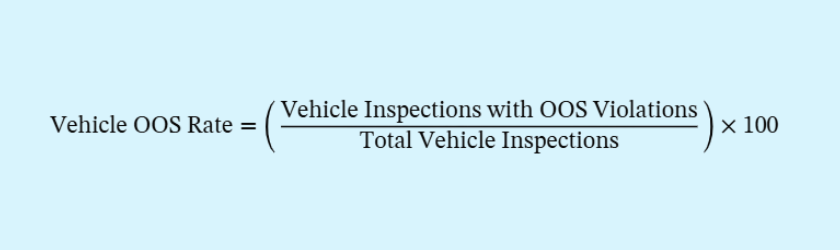
The FMCSA tracks these percentages across three separate categories: Vehicle, Driver, and Hazardous Materials (Hazmat). A high rate triggers targeted DOT interventions and frequent roadside pull-overs. Knowing your baseline via the FMCSA Safety Measurement System (SMS) is your first step toward beating the 19.0% national average.
The Math in Action:
If your fleet undergoes 50 roadside inspections over the course of a year, and 8 of those inspections result in a truck being placed out of service, your calculation looks like this:
(8÷50)×100=𝟏𝟔.𝟎% 𝐕𝐞𝐡𝐢𝐜𝐥𝐞 𝐎𝐎𝐒 𝐑𝐚𝐭𝐞
While this keeps you just under the 19.0% national average, it still means nearly 1 in 6 of your inspected trucks is failing critical safety checks, a clear sign that your preventative maintenance program needs tightening before the DOT steps in.
2. The 39.1% Problem: Targeting Brake System Failures
With brake systems making up nearly 40% of all vehicle OOS violations, your maintenance strategy must heavily prioritize the air and brake components.
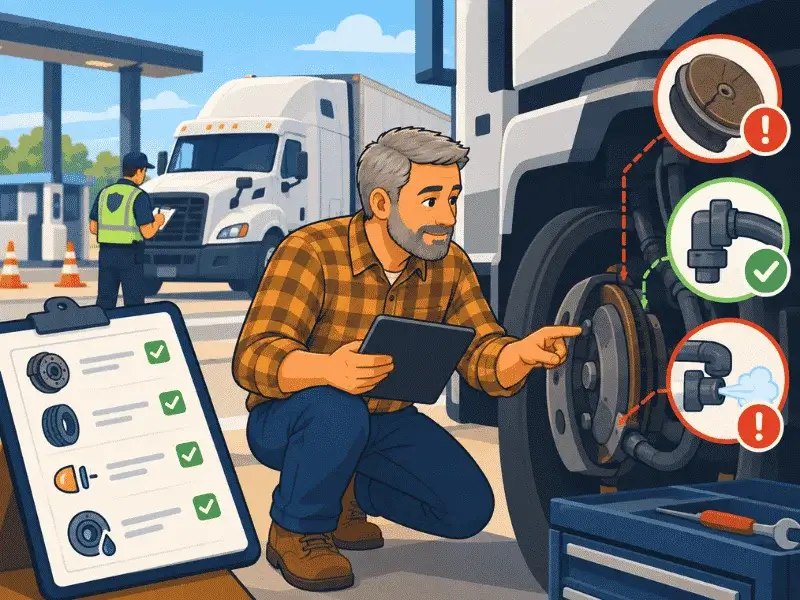
Train your drivers and technicians to hunt for these specific brake defects before every trip:
- Audible and Visual Leaks: Drivers must perform an air loss rate test. With the engine off and brakes applied, air pressure should not drop more than 3 PSI per minute for straight trucks, or 4 PSI for combination vehicles.
- Brake Adjustment: Inspect automatic slack adjusters. If a pushrod stroke exceeds allowable limits, it is an automatic OOS failure. Never manually adjust an automatic slack adjuster without diagnosing the underlying mechanical issue.
- Component Wear: Look for cracked, thin, or contaminated brake shoes and drums.
3. Standardize the 15-Minute Pre-Trip Inspection
The simplest defense against roadside violations is a rigorous, non-negotiable inspection routine before the keys ever hit the ignition. A structured 15-minute walkaround catches major defects before an inspector does.
Beyond the brake system, your drivers' pre-trip checklists must explicitly emphasize these high-risk areas:
- Wheel Seals and Tires: Look closely at the inside of the tires. Leaking steer axle wheel seals can contaminate brake linings, leading to an immediate OOS designation. Flat tires or deeply gouged sidewalls will stop a truck instantly.
- Lighting and Electrical: Test all high/low beams, turn signals, and brake lights. A simple dead bulb, like a malfunctioning stop lamp, is an open invitation for an officer to pull a truck over.
Download Our Free Fleet Maintenance Resources Now!
Prevent costly breakdowns and maximize uptime with our free checklist.
Download
4. Transition from Reactive to Predictive Maintenance
Waiting for something to break before fixing it guarantees a high OOS rate. True fleet health requires a preventative maintenance plan anchored by mileage or time intervals.
Implement automated alerts via fleet management software to track upcoming service windows. Never let a truck depart on a long haul if it is nearing its preventative maintenance window.
5. Bridge the Gap Between Drivers and Technicians
A clean Driver Vehicle Inspection Report (DVIR) should not be treated as mere paperwork. Fleet managers must foster an environment where drivers feel comfortable reporting minor defects, such as a small air hiss or an ABS warning light, without fear of losing miles or facing internal reprimands.
When a driver submits a defect report, technicians should resolve it immediately. Recurring, unaddressed minor maintenance issues eventually cascade into catastrophic mechanical failures on the road.
6. Leverage DataQs to Clean Your Record
Mistakes happen, not just by your team, but also by roadside inspectors. If a driver receives a violation that you believe was issued in error, or if a citation is successfully fought and dismissed in court, do not let it sit on your record.
Use the official FMCSA DataQs System to file an administrative challenge. Uploading solid supporting documentation, such as clean mechanic repair orders or court records, can remove erroneous violations from your Motor Vehicle Record (MVR) and SMS profile, successfully lowering your public OOS percentage.
7. Automate Prevention: How Simply Fleet Eliminates the Guesswork
You don't need a data analyst to survive the next CVSA Roadcheck; you just need a system that surfaces issues before an inspector does. Simply Fleet’s AI-powered fleet management software completely eliminates the tedious manual data entry that leads to missed service windows. Instead of digging through old inspection logs, the platform's brand-new Simply Fleet AI Insights automatically reviews your fleet's daily maintenance records, fuel logs, and vehicle inspections behind the scenes.
It scans for hidden mechanical patterns, such as a recurring slack adjuster issue or a slow-leaking air system, and proactively brings ranked findings straight to your dashboard with direct links to the problem records.
Combined with a highly customizable KPI dashboard, it ensures that your team always knows exactly which brakes, lights, or wheel seals require immediate shop attention, safely driving your vehicle OOS rate well below the 19.0% national average.
Don't let preventable brake issues or missed service windows stall your business. Explore Simply Fleet's Customizable AI Dashboard and keep your vehicles moving safely below the national OOS average.