


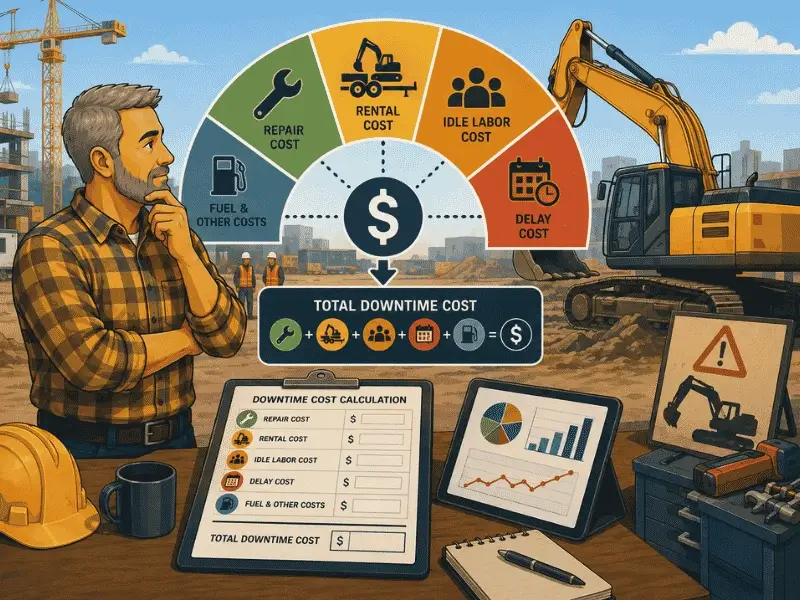


Construction Equipment Downtime Cost: How to Calculate It (and Cut It)
Key Takeaways
- Downtime cost is bigger than the repair invoice. Repairs and rentals are the visible cost, but idle crew wages, lost productivity and project delays usually add up to more.
- Unplanned downtime rates are higher than most contractors assume. Industry estimates put unplanned downtime in the 20 to 30 percent range for fleets without a consistent maintenance program, and that adds up fast across a mixed fleet.
- Planned downtime and unplanned downtime are not the same cost. A scheduled service window is budgeted and absorbed. An unplanned failure hits mid-shift, with no warning and no plan around it.
- A simple formula makes the cost visible. Combining repair cost, rental cost, idle labor cost and delay cost into one number turns downtime from a vague frustration into a figure leadership can act on.
- Inspections and preventive maintenance are what actually move the number. Catching a defect during a pre-shift inspection is a fraction of the cost of catching it after the machine has already failed on site.
A single machine going down for a shift can cost far more than the repair bill. This guide breaks down every cost layer of construction equipment downtime and gives contractors a practical way to calculate what a breakdown is really costing them.
The cost of construction equipment downtime is much higher than the repair invoice most contractors think about first. Every hour a machine is out of service affects multiple parts of the job, from the operator waiting on repairs to crews that can't continue their work until the equipment is available again. If replacement equipment has to be rented at short notice or project milestones start slipping, the financial impact grows even further.
The true cost of downtime combines direct repair expenses with indirect costs such as idle labor, reduced productivity, equipment rentals, schedule delays, and, in some projects, contractual penalties. Looking at all of these together gives contractors a much more realistic picture of what an unexpected breakdown is actually costing the business.
Ask a contractor what a breakdown costs and most will quote a repair invoice. That number is real, but it's usually the smallest piece of the total. A hydraulic pump failure on an excavator doesn't just cost the parts and labor to fix it. It costs every hour the crew stands around waiting, every hour a rented machine has to fill the gap, and every day the schedule slips as a result.
This guide walks through the full cost of construction equipment downtime, layer by layer, and gives you a straightforward way to estimate what a breakdown is actually costing your project. It also looks at where inspections and preventive maintenance fit into bringing that number down.
What Costs Should Be Included When Calculating Equipment Downtime?
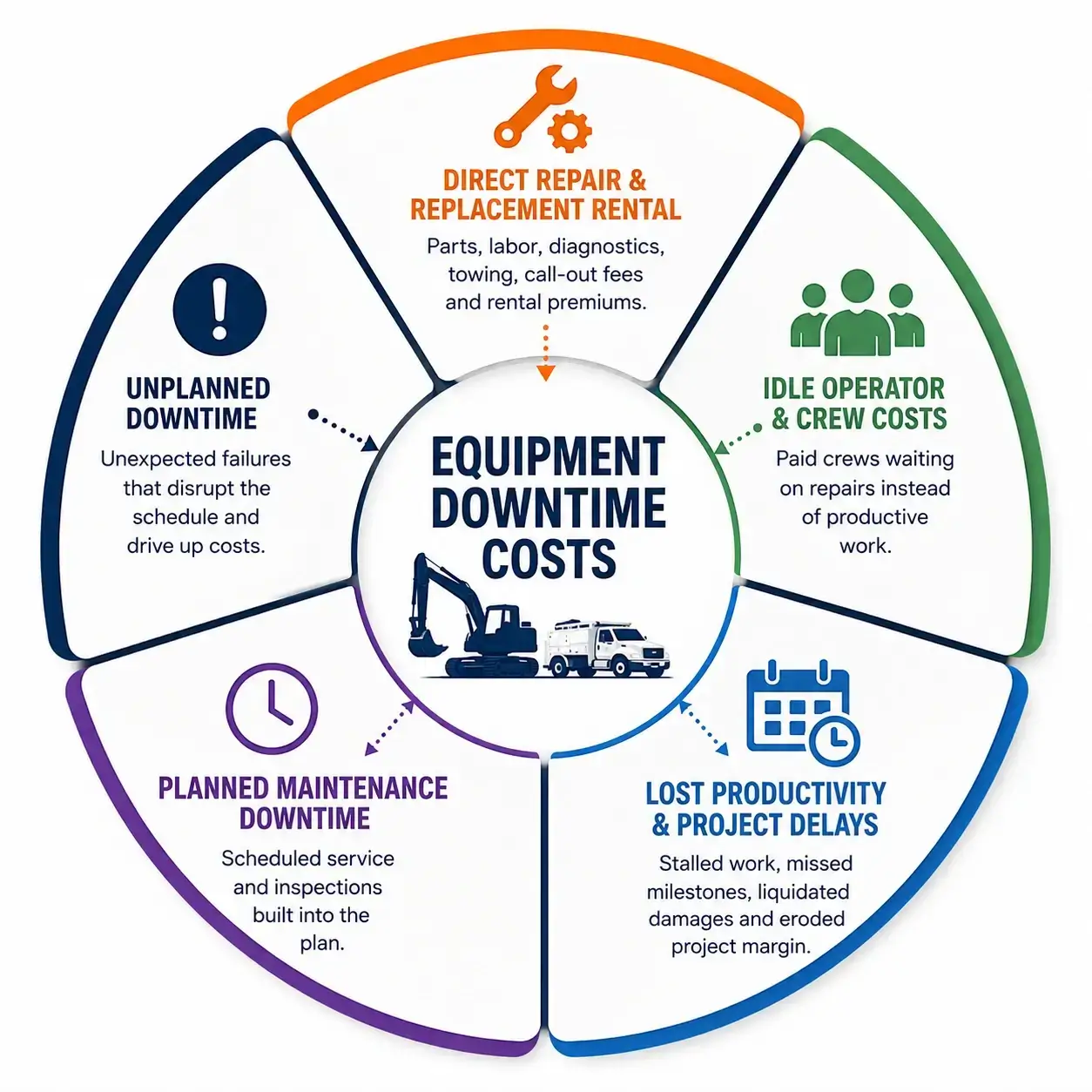
Repair costs are only one part of the equation. In practice, a single breakdown often creates several additional expenses that are tracked under completely different budgets, making the total impact easy to underestimate.
The most obvious costs are replacement parts, technician labor, towing, and emergency call-out charges. If the equipment can't return to service quickly, many contractors also need to rent a replacement machine to keep work moving. That rental premium becomes part of the breakdown cost because it wouldn't have existed without the failure.
The indirect costs are often even larger. Operators and ground crews may spend hours waiting for equipment to return to service, planned work gets pushed back, and other subcontractors can find themselves delayed even though nothing has gone wrong with their own work. By the time the repair is complete, the total financial impact frequently extends well beyond the maintenance department.
Direct Repair and Replacement Rental Costs
This is the cost most fleet managers already track, because it shows up on an invoice. It includes parts, labor, diagnostic time, towing if the machine can't be moved under its own power, and any emergency service call fees for after-hours work.
If the failure takes a machine out of service for longer than the project can absorb, a rental usually fills the gap. Rental rates on heavy equipment run well above what the equivalent owned hour would cost, since the contractor is paying for availability on short notice rather than a planned, competitively priced rental. That premium is part of the downtime cost, even though it often gets coded to a different line item and never gets connected back to the failure that caused it.
Idle Operator and Crew Costs
A machine that isn't running usually means a crew that isn't working either. When an excavator goes down, the operator and the ground crew assigned to it are frequently stuck waiting on diagnosis, parts and repair, whether or not they can be reassigned depends on the job and the schedule.
Crews are often paid a burdened rate that includes wages, benefits and overhead, so an hour of idle time is more expensive than the base wage suggests. A four or five person crew earning a combined rate in the hundreds of dollars per hour adds up quickly across a full shift, and it adds up again every time the same pattern repeats across a fleet.
Lost Productivity and Project Delay Costs
This is the layer that's easiest to underestimate and hardest to walk back once it happens. A stalled crew doesn't just cost wages, it costs the work that didn't get done, and that work often has downstream dependencies. Grading that doesn't happen on schedule pushes back foundation work. A late foundation pushes back framing. One breakdown on day three of a project can still be felt in week six.
Many commercial contracts also carry liquidated damages clauses for late completion, meaning a delay caused by equipment downtime can turn into a contractual penalty on top of the operational cost. Even without a formal penalty clause, missed milestones strain subcontractor relationships and eat into the margin the project was supposed to protect.
According to an industry analysis published by For Construction Pros, unplanned downtime rates in the range of 20 to 30 percent are common among fleets without a strong preventive maintenance program. At that rate, a contractor running 50 pieces of equipment can be looking at losses approaching $2 million a year, and that figure climbs toward $8 million for a 200 asset fleet.
Planned Versus Unplanned Downtime
Not all downtime is equal, and treating a scheduled oil change the same way you'd treat a mid-shift engine failure misses the point entirely.
Planned downtime is a cost you've already accounted for. Unplanned downtime is a cost you're discovering in real time, usually at the worst possible moment on the schedule. Shifting more of a fleet's maintenance from the unplanned column to the planned one is, in practice, the single biggest lever contractors have over their total downtime cost.
Download your FREE Heavy Equipment Checklist!
Prevent costly breakdowns and maximize uptime with our free checklist.
Download
Why Does Unplanned Downtime Cost So Much More Than Planned Maintenance?
At first glance, both planned maintenance and unexpected repairs take equipment out of service. The difference is that one is expected and the other interrupts work when the project is least prepared for it.
Scheduled maintenance can usually be arranged around production, allowing managers to plan workloads and minimise disruption. An unexpected engine or hydraulic failure doesn't offer that flexibility. Operators stop working immediately, supervisors begin reorganising schedules, replacement equipment has to be sourced, and project timelines start shifting.
For that reason, two maintenance events lasting the same number of hours rarely cost the same amount. The planned service is part of the operating budget. The unexpected breakdown creates additional costs that continue accumulating until normal operations resume.
Illustrative Downtime Cost Formula
The numbers below are illustrative only, meant to show how the pieces fit together rather than to represent a specific machine or project. Swap in your own numbers to get a figure that reflects your fleet.
Total Downtime Cost = Repair and Rental Cost + (Idle Crew Rate × Downtime Hours) + Estimated Delay Cost
As an illustrative example: if a mid-size excavator failure costs $3,000 in parts, labor and a two day rental, the four person crew assigned to it is idle for 8 hours at a combined burdened rate of $180 per hour, and the resulting schedule slip carries an estimated delay cost of $2,500, the total illustrative downtime cost for that single incident comes to roughly $6,940. Multiply a version of that calculation across a fleet experiencing breakdowns several times a month, and the case for reducing unplanned downtime tends to make itself.
The Hidden Costs of Equipment Breakdowns
Some of the most expensive consequences of equipment downtime never appear on a repair invoice.
When a critical machine fails, supervisors often spend valuable time coordinating repairs, sourcing replacement equipment, updating schedules, and communicating with customers or subcontractors. Projects may require overtime later in the week to recover lost progress, while equipment utilisation across the fleet becomes less efficient as other machines are reassigned to fill the gap.
These costs are difficult to measure individually, but together they explain why the financial impact of a breakdown is often significantly higher than the repair itself. Understanding these hidden costs also makes it easier to justify investments in inspections and preventive maintenance before failures occur.
Which Construction Equipment Creates the Highest Downtime Costs?
Not every machine carries the same financial risk when it breaks down. Equipment that sits on the critical path of a project usually has the greatest impact because several other activities depend on it being available.
For example, an excavator that stops working during site preparation can delay foundation work, while a crane breakdown may leave multiple subcontractors waiting until scheduled lifts can resume. Likewise, wheel loaders and bulldozers often support several crews simultaneously, meaning a single failure can slow productivity across the entire site rather than affecting just one operator.
Rather than focusing only on repair costs, contractors should identify which machines have the greatest operational impact when they become unavailable. Those assets typically deliver the highest return from proactive maintenance and inspection programs.
How Inspections and Preventive Maintenance Reduce Downtime
Nearly every unplanned failure has a warning sign somewhere before it. A fluid leak, an unusual noise, a warning light, a component that's been flagged as worn on the last three inspections but never got scheduled for service. The gap between when a warning sign appears and when it turns into a mid-shift failure is exactly where preventive maintenance and consistent inspections do their work.
A construction fleet management system gives fleet managers one place to see inspection results, open issues and maintenance history across every machine on every job site, instead of piecing that picture together from paper forms and phone calls. When a defect gets flagged during an inspection, it should convert directly into a work order rather than sitting in a notebook until someone remembers to act on it. That connection alone closes one of the most common gaps that turns a minor defect into an unplanned breakdown.
Preventive maintenance software for construction equipment takes this a step further by scheduling service based on engine hours, meter readings or calendar intervals rather than relying on someone's memory or a spreadsheet. Machines get serviced on a predictable cadence, and fleet managers can see what's coming due before it becomes an emergency. Over time, that shift from reactive to planned maintenance is what moves a fleet's downtime ratio in the right direction and keeps the biggest cost layers of a breakdown, idle crews and blown schedules, from happening in the first place.
In Practice: Why Small Defects Become Expensive Breakdowns
One pattern appears repeatedly across construction fleets. Major failures rarely happen without warning.
Hydraulic leaks often begin as small drips. Bearings become noisy before they seize. Warning lights appear long before a machine refuses to start. None of these issues automatically lead to expensive downtime, but they become far more costly when they're noticed during production instead of during a planned inspection.
The difference between planned and unplanned maintenance is usually not the repair itself. It's when the repair is discovered. Finding problems early gives maintenance teams the flexibility to schedule repairs around project demands instead of reacting after work has already stopped.
When I was researching equipment downtime, I noticed that almost every article focused on calculating repair costs. Very few explained what happens after the machine stops working. That's where contractors often lose the most money. Idle operators, delayed crews, replacement rentals, and missed milestones don't usually appear on the same invoice, but together they represent the real cost of downtime. Looking beyond the repair bill gives fleet managers better information for maintenance planning, budgeting, and long-term fleet decisions.
Research Note: The downtime examples and calculations in this guide are intended to illustrate how different cost categories contribute to the overall financial impact of an equipment breakdown. Actual costs will vary depending on equipment type, labour rates, project schedules, fleet utilization, and the availability of replacement equipment. Where possible, operational decisions should be based on maintenance records, inspection history, and job-specific cost data rather than industry averages alone.