



Introduction
If you’re searching for “best fleet maintenance software,” you’re probably not looking for another dashboard.
You’re looking for a system that actually sticks—where inspections happen on mobile, defects don’t vanish into text messages, work orders get closed with costs and parts attached, and you can finally answer the question: “What’s really driving downtime?”
In my experience, most tools don’t fail because they “lack features.” They fail because the workflow breaks somewhere between inspection → defect → work order → parts → close-out → service history → reporting.
This list focuses on commercial fleets in the US (trucking, construction, mixed, municipal) and the scope defined as: PM scheduling, service history, reminders, work orders, inspections/DVIR-style workflows, parts/inventory, reporting, compliance records.
Top Picks for 2026

Simply Fleet

Fleetio

RTA Fleet 360
Why Trust Simply Fleet
We built this guide the same way we’d want it if we were buying software for a real fleet: focused on whether the system actually holds up in day-to-day operations, not just whether a feature exists on a checklist.
To keep comparisons grounded, we used three inputs:
Hands-on ops lens: We evaluated each product against real workflows—PM scheduling, inspections, issues/defects, work orders, parts/inventory, reporting, and day-to-day usability.
Public docs + pricing pages: If something couldn’t be verified publicly, we treated it as “needs confirmation” instead of assuming.
Verified third-party reviews: We used review platforms (e.g., G2/Capterra) to spot repeated themes—support quality, usability, rollout friction.

How we ranked
Ease of Adoption (Setup + UX)
How quickly a fleet can get working without “admin heroics.” Data import, role setup, day-one usability.
Mobile + Offline Execution (Inspection-first reality)
Whether drivers/techs can reliably complete inspections and updates in the yard, at job sites, or with poor reception—and whether the workflow is frictionless enough to enforce.
Maintenance Workflow Completeness
Does it cleanly connect: inspection → defect/issue → work order → parts → close-out → service history → reporting?
Parts/Inventory Depth (if in scope)
Consumption, low-stock, cost attribution, and whether inventory is genuinely operational (not just a list).
Reporting + Compliance Readiness
Can you answer real management questions (downtime drivers, cost by vehicle, overdue trends) and keep records in a way that stands up internally.
Integrations That Matter to US Fleets
Fuel/fuel cards, accounting, telematics (native vs marketplace vs Zapier/API), and the realism of actually implementing them.
Support + Onboarding Model
CSM vs ticket-only, onboarding/training included vs paid, and how much help teams get during rollout.
Pricing / Budget Fit
This category scores whether the product’s pricing model and “fine print” match real-world fleet budgets and procurement reality—especially for commercial SMB fleets moving from paper/spreadsheets to software.
Comparison Table
1) Simply Fleet
When I’m evaluating fleet maintenance software, I’m not looking for “features.” I’m looking for whether the tool can survive real-world operations: drivers skipping steps, techs closing work late, parts disappearing, and the fleet manager drowning in follow-ups.
Simply Fleet is the cleanest option here because it’s built around the full maintenance loop—and it’s designed to reduce the admin friction that usually kills adoption.

Why I ranked it #1
I ranked Simply Fleet as the best all-around fleet maintenance software because it combines a complete maintenance workflow with practical AI that cuts admin time. It’s one of the few platforms that’s both workflow-complete and fleet-operationally realistic.
That combination matters more than people think.
Features
- AI that reduces busywork (Simply Ask + scan/voice)
Simply Ask helps you pull answers quickly without building reports from scratch. Scan and voice workflows reduce manual entry for routine items like invoices/receipts and fuel/mileage, so records stay current. - End-to-end maintenance workflow
PM scheduling, inspections, issues, work orders, service history, and reporting are designed to run as one connected loop. That’s what prevents defects and tasks from disappearing between modules. - Mixed fleet support (vehicles + equipment + tools)
It’s built for the reality that many fleets track more than vehicles. You can manage different asset types and keep maintenance history consistent across the fleet—not split across spreadsheets. - Inspections that are schedulable and auditable
Inspection forms can be scheduled with reminders, and submissions are trackable. Photos and signatures add proof when you need documentation, not just “we do inspections.” - Parts and inventory
You can track parts usage, costs, and warranties with enough structure to control spend. It’s designed to help most fleets stay organized without heavy process overhead.
Review
“In my 19 years working in the transport industry, Simply Fleet is the ONLY software program that I have come across that is user friendly, adaptable to my operations, accurate with reporting and very cost effective saving the company a lot in wasted fuel and maintenance costs."

Pros
- Fast adoption and quick ROI: It’s easy to get started, and teams typically see value quickly because the workflow is straightforward.
- Less admin load: The AI features reduce the “busywork tax,” which is why data quality and follow-through tend to hold up over time.
- Strong customer support and customer success: The product feels backed by a team that helps customers get set up and succeed, not just “use the app.”
- Constant product innovation: The platform keeps pushing toward simpler workflows and easier inputs, which matters more than adding niche features.

Cons
- Limited native integrations: If you need a deep integration stack (especially accounting), you’ll likely rely on exports or custom workflows.
- Inventory is not PO-driven yet: Parts tracking is useful, but it doesn’t automatically trigger purchase orders or a full replenishment workflow today.
$0/mo
$2/veh/mo
$4/veh/mo
2) Fleetio
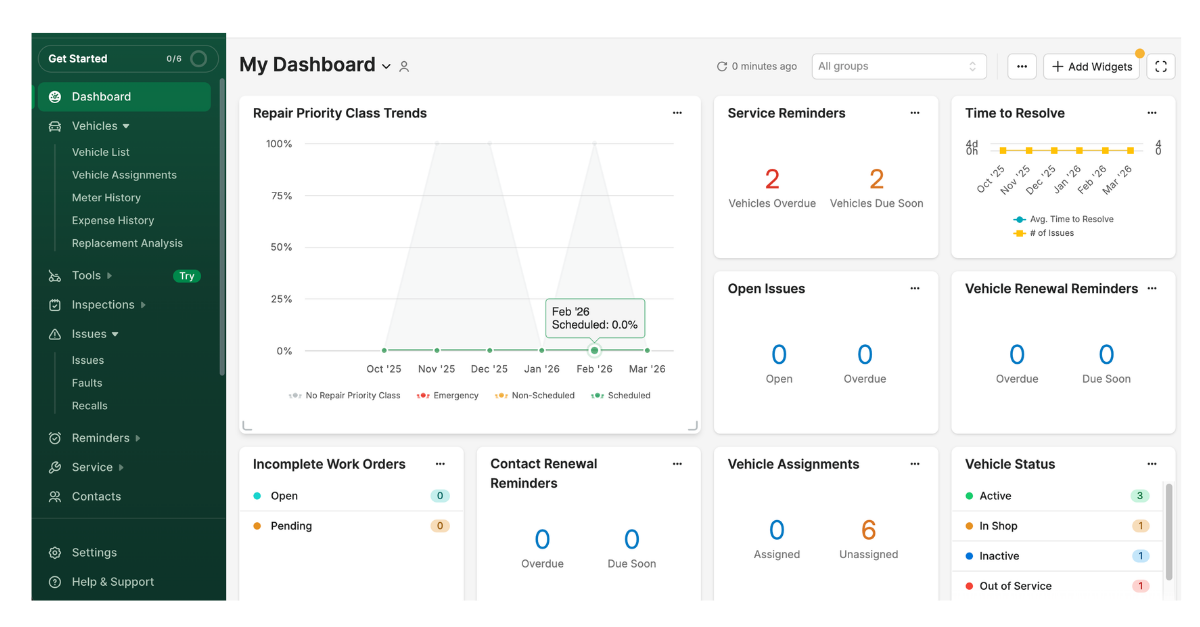
Fleetio is what I point to when a fleet already has process discipline and wants a mature, well-known system. It’s strong on the fundamentals like PM, inspections, work orders, and reporting, and it rewards teams that care about data quality. The tradeoff is that it can feel like “a lot of system” if you’re coming straight from spreadsheets.
Features
- PM scheduling, inspections, and service tracking are core strengths—this is where Fleetio feels most complete.
- Work orders tied to failed inspection items, which helps close the gap between “we found a defect” and “we fixed it.”
- Inventory/parts functionality is available, but some work-order and inspection depth varies by tier (worth confirming by plan).
- Strong integration ecosystem, including fuel cards and telematics directories (helpful if you’re already running multiple systems).
Review
“Fleetio makes managing fleets incredibly easy… I can create maintenance schedules, inspection forms, or expense reports quickly.”
Pros
- Mature maintenance platform with strong reporting and a broad integration ecosystem.
- Inspection + maintenance workflows are structured enough to standardize PM at scale.
Cons
- Fleetio offers a broader range of features, which may be important for larger fleets or those with more complex needs
- Easy to use and intuitive interface.
3) RTA Fleet360
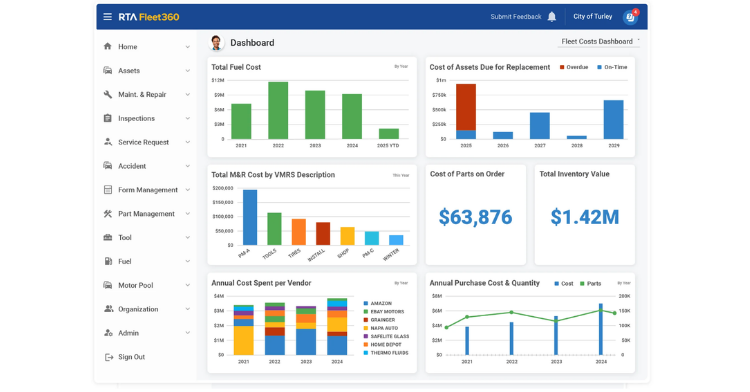
RTA is shop-first. If you’re running serious in-house maintenance—real work orders, real parts discipline, real purchasing controls—RTA is built for that reality. It’s not trying to be lightweight; it’s trying to make the shop run tighter.
Features
- End-to-end maintenance flow designed for shop throughput (PM → work orders → history).
- DVIR/inspections and maintenance recordkeeping are part of the system (good for compliance readiness).
- Strong parts/inventory and purchasing discipline—this is where “fleet apps” often fall apart.
- Reporting supports PM compliance and work order tracking (good for supervisors and audits).
Review
"RTA has allowed us to be more efficient in the maintenance of our fleet. The PM'S due have decreased because of the alerts we recieve"
Pros
- Enterprise backbone: deep maintenance + inventory + reporting built for governance and multi-location controls.
- Offline/store-and-forward mobile options fit environments with weak connectivity.
Cons
- Heavier rollout and change management—typically not “self-serve in a week.”
- Enhancements/changes can be expensive and procurement is usually sales-led.
4) AssetWorks FleetFocus
FleetFocus is an enterprise fleet backbone. I think of it as a system you buy when you need governance, multi-location controls, and deep reporting—not when you want a quick self-serve rollout. If you have formal procurement and implementation capacity, it’s built for that world.
Features
- Broad “all-in-one” fleet management + maintenance platform with deep operational coverage.
- Strong reporting depth (often a primary reason organizations choose it).
- Mobile/offline support exists in the ecosystem (store-and-forward/disconnected approaches are part of how it’s deployed).
- Enhancements and change requests can carry meaningful cost—this is not lightweight self-serve software.
Review
“Its an all in one system that covers all you would need to cover for a fleet management system.”
5) Cetaris
Cetaris is for fleets that treat maintenance like a financial system: warranty capture, component economics, and serious reporting. It’s not built for lightweight buying motions, but it can be powerful when leadership cares about cost accountability at scale.
Features
- Reporting depth and warranty-focused workflows show up as major strengths in customer feedback.
- Designed for larger, process-heavy maintenance environments where governance and auditability matter.
Review
“Cetaris has reporting for everything we need. Warranty module is excellent!”
Pros
- Deep maintenance economics (warranty + cost accountability + reporting) built for serious ops teams.
- Strong integration categories (fuel, accounting, telematics) for enterprise environments.
Cons
- Sales-led, implementation-heavy buying motion (not designed for quick onboarding).
- Users flag API/data access constraints and extra cost to access their own data.
6) Samsara
Samsara is telematics-first, but it’s increasingly credible for maintenance workflows—especially if you already run Samsara across safety, dispatch visibility, and driver workflows. If the hub of your operation is live vehicle data, Samsara is built for that.
Features
- Strong real-time visibility into vehicles/equipment and operational performance (the platform’s core value).
- Maintenance workflows benefit from telematics signals and DVIR/driver execution in the same environment.
Review
“The user-friendly system and clean dashboard make tracking vehicles… really easy. I appreciate the real-time visibility into our fleet.”
Pros
- Telematics + safety as the hub, with maintenance workflows improved by live vehicle data and DVIR execution.
- Strong real-time visibility that ops teams actually use daily
Cons
- Not a shop-first maintenance system; deeper inventory/PO workflows usually require another tool.
- Integrates with popular fuel cards and GPS tracking systems.
7) Geotab
Geotab is a data platform first. If you want deep diagnostics, a large partner ecosystem, and strong operational visibility, it’s a serious contender. But for maintenance, many fleets either use Geotab’s tooling selectively or connect it into a dedicated maintenance system.
Features
- Real-time tracking and strong ecosystem signals are central to why fleets adopt it.
- Reporting depth can be powerful, but some users find reporting overwhelming at first.
- Maintenance workflows often depend on how you configure the stack (native vs integrated CMMS).
Review
“Users consistently praise Geotab for its user-friendly interface and real-time tracking capabilities…”
Pros
- Excellent diagnostics/telematics platform with a huge ecosystem; strong for data-driven operations.
- Flexible if you want to integrate into a dedicated maintenance system via marketplace partners.
Cons
- Partner-sold pricing and hardware can complicate budgeting vs pure software.
- Mobile/UX and reporting complexity come up in user feedback (learning curve)
8) Motive
Motive is best when compliance and safety workflows drive the operation—and maintenance is managed alongside that. If your leadership cares about coaching, visibility, and enforceable field behavior, Motive tends to fit. For deep maintenance economics, you may still pair it with a dedicated maintenance system.
Features
- Strong safety + equipment reporting and coaching workflows show up as key benefits.
- Maintenance tracking exists as part of the operational suite, but depth depends on how you use the platform and integrations.
Review
“Very good system… Easy to navigate, good safety and equipment reporting. Makes coaching easy and helps change driver behavior.”
Pros
- Strong compliance + safety + operational visibility; works well when those are top priorities.
- Implementation/training options exist for fleets that want guided rollout.
Cons
- Hardware + contract structure can push total cost up depending on package.
- For full maintenance economics (inventory/PO depth), many fleets still pair it with a dedicated maintenance platform.
9) Teletrac Navman (TN360)
TN360 is one of the clearer “telematics + maintenance module” stories in this list. If you want telematics visibility but don’t want maintenance to be an afterthought, TN360 can be a workable middle ground—especially when you lean into its platform features.
Features
- Real-time tracking with a strong visual layer (“drone view” style visibility) is a frequent highlight.
- The platform leans into analytics/insights to explain operational issues (delays, fuel, efficiency).
Review
“Real time tracking of fleet assets to meet customer demand with great visual representation.”
Pros
- Clear “telematics + maintenance module” story vs many telematics vendors; maintenance schedules tied to odometer/engine hours.
- Integrates with popular fuel cards and GPS tracking systems.
Cons
- Shop/inventory depth is limited compared to maintenance-first systems.
- Integrates with popular fuel cards and GPS tracking systems.
10) Verizon Connect
Verizon Connect is strong at what it’s historically been strong at: fleet visibility, GPS tracking, and reporting. I don’t typically treat it as the “maintenance brain” unless you pair it with a maintenance-first system, but it can be an effective operational layer for many fleets.
Features
- Reporting and GPS replay are practical strengths (operators actually use these daily).
- Works well for utilization/visibility and operational reporting, especially when dispatch and field coordination matter.
Review
“The simplicity to add vehicles… run reports… true GPS updates and the replay feature is amazing.”
Pros
- Strong GPS tracking, utilization visibility, and operational reporting—teams use the basics daily.
- Works well as an ops visibility layer, especially for field-heavy fleets.
Cons
- Not a full maintenance “system of record” by itself; end-to-end maintenance usually requires another tool.
- Integrates with popular fuel cards and GPS tracking systems.
How to choose in 5 minutes
Final recommendation
If you’re a US fleet that’s mixed, growing, and trying to move from “we think we’re doing maintenance” to “we can prove it and manage it,” Simply Fleet is the strongest overall choice. It’s aligned with real-world constraints behind this search: adoption, mixed assets (including equipment), inspection proof, follow-through, and reporting—without forcing you into a heavyweight implementation or a buying model that assumes you’re already enterprise.
For fleets evaluating the full ops picture, the best fleet management tools page covers nine platforms across maintenance, telematics, and shop ops.