

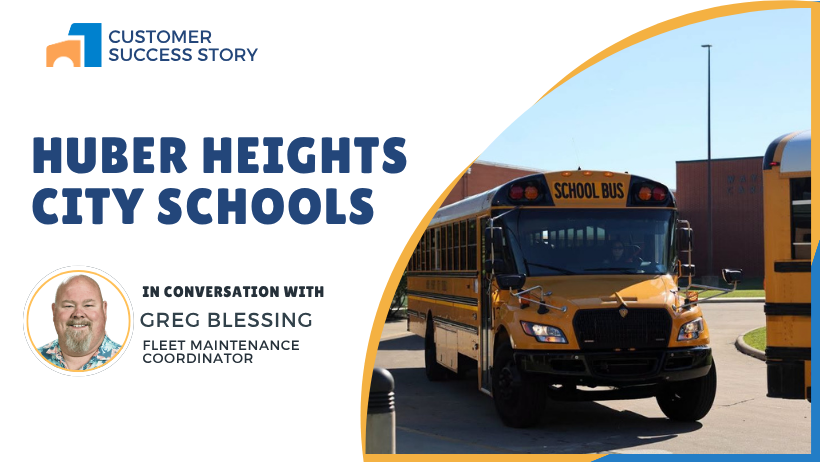
Huber Heights City Schools in Huber Heights, Ohio, manages a growing fleet of buses responsible for transporting students every day. When Fleet Maintenance Coordinator Greg Blessing decided to move on from the district's previous software, he chose Simply Fleet to bring structure, visibility, and automation to a maintenance operation he runs largely on his own. With Simply Fleet's maintenance reminders, automated work order creation, parts inventory management, and a seamless Samsara integration, Greg has replaced hours of manual data entry with a system that works the way his shop does: organized, proactive, and always a step ahead.
Meet the Champion
Greg Blessing is the Fleet Maintenance Coordinator at Huber Heights City Schools. He manages and maintains the district's bus fleet largely on his own, handling everything from scheduling preventive maintenance to diagnosing issues in the shop. Greg came from a system that never quite fit the way he worked, and he brought a clear set of requirements when he started evaluating alternatives: something intuitive, something that connected to the tools he already used, and a team that would actually help him get set up properly.
The Challenge
Running maintenance for a school bus fleet is a job where staying ahead of the schedule matters. Buses run routes every day, and when one goes down unexpectedly, the impact is felt immediately. Greg was managing this responsibility using Dossier, a system he had been put on without proper training and never found his way around.
The interface required too many steps to retrieve basic information. Finding service history, checking what was due on a specific bus, or pulling any kind of report meant navigating a system that was not built with the technician in mind. The cost, relative to what the software actually delivered, added to the frustration.
The mileage tracking process compounded the problem. Samsara, the district's telematics system, had no direct connection to their fleet management workflow. Every week, Greg had to pull mileage data from Samsara manually and re-enter it into Dossier by hand, a recurring task that added no value and existed only because the two systems did not speak to each other.
Why Simply Fleet
Greg evaluated Simply Fleet against his day-to-day reality as a working technician and coordinator. The interface was immediately accessible, the feature set matched what he actually needed, and the pricing was a significant step down from what the district had been spending on Dossier. But the deciding factor may have been the onboarding experience. The Simply Fleet team, led by Rishparna, handled the data migration: vehicles loaded, parts inventory transferred, Samsara connected. Greg did not have to start from scratch or spend weeks getting the system ready before he could use it.
Getting Started
The transition happened mid-year, which Greg had been concerned about. In practice, the handoff was smooth. With the Simply Fleet team managing the heavy lifting on data import and integration setup, Greg was working in the platform almost immediately. Within the first few months, he had built out a structured preventive maintenance program with reminders set at 4,000, 8,000, and 12,000 mile intervals across the fleet, each one configured to automatically create a work order when triggered and send him an email alert. The shop had a system that matched the way it actually operated.
"I was dreading switching fleet maintenance software mid-year, but Rishparna and the Simply Fleet team made the switch as painless as possible. They integrated my Samsara system and input the data for each of my vehicles and parts inventory. The overall experience has been great."
— Greg Blessing, Fleet Maintenance Coordinator, Huber Heights City Schools
How Greg Uses Simply Fleet
Greg starts his day on the dashboard, where he checks three things:
- which vehicles are currently down
- what services are coming due across the fleet
- overall cost visibility
It is the same information he needed before, now in one place without having to dig for it.
The preventive maintenance program runs largely on its own. When a bus reaches its service interval, a reminder fires, a work order is created, and Greg gets an email. He works through the job, logs parts consumed from the inventory, records the service, and closes out the work order. The process is clean and leaves a complete record against each vehicle.
The Samsara integration sits underneath all of it. Daily odometer readings come in automatically across the fleet, which means every mileage-based reminder is always working from accurate, current data. The weekly manual mileage update that once connected two disconnected systems is gone entirely.
When something comes up outside of a scheduled service, Greg logs it as an issue directly. Of the issues raised since going live, nearly all have been resolved and closed out. The record is there, tied to the vehicle, the next time he needs it.
He has also begun exploring the AI assistant in reporting, and his experience with it captures what makes the feature useful:
"When I first started using the AI assistant, I was trying to pull a parts inventory report. I reworded my query and was able to retrieve exactly what I was looking for. It is surprisingly easy once you know how to talk to it."
— Greg Blessing, Fleet Maintenance Coordinator, Huber Heights City Schools
Simply Fleet Features in Use
The Difference It Made
In the months since going live, Greg has built a maintenance operation that runs the way a well-run shop should:
- A weekly manual process of pulling mileage data from Samsara and re-entering it into Dossier has been replaced by an automatic daily sync. That time is now spent on the work itself.
- Preventive maintenance runs on a structured, mileage-based schedule. When a bus hits its interval, the system handles the notification and work order creation. Nothing falls through.
- A parts inventory of hundreds is live in the system, with parts consumed tracked against individual jobs, giving Greg a clear picture of what is being used and when.
- Service history is accessible by vehicle at any point, making it faster to diagnose recurring issues and make informed decisions on repairs.
- The AI reporting assistant has opened up a reporting capability that previously required navigating a system that was not built with usability in mind.
Looking Ahead
As Huber Heights City Schools continues to grow its use of Simply Fleet across the fleet, the PM program, parts tracking, and service history Greg has built will extend to cover every vehicle in the district. He has also expressed interest in bringing building maintenance vehicles onto the platform, pointing to a system that can scale alongside the district's needs without requiring a new solution when those needs change.
Would They Recommend It?
Greg came into Simply Fleet as someone who had experienced firsthand what a difficult system costs in time, patience, and wasted effort. His recommendation carries that context.
"The dashboard layout is very easy to follow and find what you might be looking for. I have enjoyed sharing ideas with the team at Simply Fleet. They are very open and helpful with updates very regularly. The most recent update was a great addition to an already user friendly software."
— Greg Blessing, Fleet Maintenance Coordinator, Huber Heights City Schools
Your Fleet Deserves the Same
Greg did not rebuild his maintenance operation from the ground up. He replaced a system that was getting in his way with one that works the way his shop does: organized, automated, and always current. Within months, a weekly manual task was eliminated, a structured PM program was running across the fleet, and a parts inventory that previously lived in his head had a home in the system. Simply Fleet is built to do exactly that, quietly and reliably, behind everything your fleet already does. If your operation is ready for the same, visit simplyfleet.app to get started.