

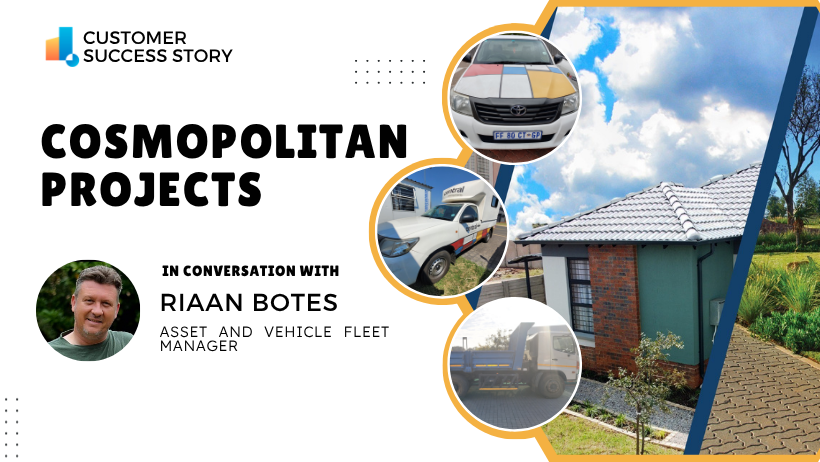
Cosmopolitan Group develops land across South Africa: groundworks, civil engineering, housing estates, and retirement villages. Running those projects takes a fleet of 170 vehicles spread across active sites and split across several companies within the group, each with its own insurance cover and compliance obligations. All of it is managed by one person. This is how Riaan Botes uses construction fleet management software to keep every vehicle, renewal, and service record in a single system, and why he says it has given him back his time.
Customer Snapshot
Meet the Champion
Riaan Botes is the fleet manager responsible for every vehicle across the Cosmopolitan Group and its subsidiary companies. He joined when the group had no formal fleet system in place, built the process himself, and has run it on Simply Fleet since early 2023. He is the primary administrator on the account: the person who built the inspection forms, set the reminders, and wrote Simply Fleet into the company’s operating directives. In a business where vehicles are constantly moving between development sites, he is the single point of accountability for all of them.
The Challenge
Construction fleets are difficult to manage for reasons that have little to do with vehicle count. Vehicles move between sites. Different projects sit under different companies. Insurance, documentation, and licence renewals vary by entity. A fleet manager in this position is not simply tracking vehicles: he is tracking which company owns what, which policy covers which vehicle, and what falls due next across all of it.
When Riaan joined Cosmopolitan, there was no system at all. He built his own spreadsheets to track services, licences, fuel, and renewals. That worked while the fleet was smaller. As the group grew and more companies came under his remit, the approach stopped scaling.
The problem was fragmentation. Licences in one sheet, services in another, insurance in a third, each split again by company. Building a complete picture of a single vehicle meant opening several files and assembling the answer by hand. Across a fleet this size, spread over multiple sites and multiple companies, that becomes a full-time administrative job sitting on top of the actual work.
“With spreadsheets you’ve got a lot of sheets open to try and pull it into one thing. It just makes more sense having a program that does that.”
Riaan Botes, Fleet Manager, Cosmopolitan Group
Riaan also found the software market poorly matched to an operation like his. Most platforms were built either for enterprise fleets running into the thousands or for very small operators with a handful of vehicles. There was little designed for the middle, and almost nothing that assumed a fleet might be split across several companies rather than sitting neatly under one.
“You’ve either got the fleet systems for a thousand cars, or for ten cars. There aren’t too many of them that are in between.”
Riaan Botes
One Fleet, Several Companies
The structural complexity is worth dwelling on, because it is the part most fleet software is not built for.
Cosmopolitan does not operate as a single company. Like most development groups, it runs projects through separate legal entities: shared services, asset management, project management, and development companies each holding their own vehicles. Every one of those companies carries its own insurance cover, with its own policy, its own renewal date, and its own premium schedule. The vehicles themselves move between sites regardless of which entity owns them.
Most platforms assume one company, one policy, one set of rules. Cosmopolitan needed something that could hold all of it in one place while keeping the cost and compliance record for each company distinct. That is what Simply Fleet does here: a single operational view for Riaan, with the underlying detail attributable to whichever company it belongs to.
For a development group, this is not an edge case. It is how the industry is structured.
Why Simply Fleet
Riaan ran the trial for three to four weeks before contacting the team. What convinced him was not any single feature but how the product behaved: actively developed, built to adapt, and backed by a team that responded to feedback rather than deflecting it.
Cost mattered, as it does in any business decision, but it was not the deciding factor. Capability and support carried more weight. Three years on, that judgement has held. Riaan raises what he needs from daily use, and features he has asked for have made their way into the product.
“If you’re getting something that can accommodate all your needs and it does what you want it to do, then you don’t actually mind paying a reasonable amount.”
Riaan Botes
Simply Fleet is now written into Cosmopolitan’s company directives. Anyone who drives a group vehicle logs through the platform. That was Riaan’s decision, and it says something about his confidence in the system: it is not a tool running alongside the real process. It is the process.
“We’ve actually written it into our company directives. If you use anything fleet-wise, it has to go through Simply Fleet.”
Riaan Botes
Getting Started
Rolling out a new system across drivers working on active construction sites takes time, and Riaan is straightforward about it. Getting everyone onto the platform and into consistent daily habits took around six weeks. Newer employees picked it up immediately, because for them it was simply part of the job. Longer-serving staff took more convincing: being asked to log something you have never logged before feels like an imposition when you have worked a different way for twenty years.
“It’s easier to teach a new person starting to use it, because then it’s part of what he has to do. Teaching someone that’s been here for twenty years is harder, because all of a sudden it’s an intrusive thing.”
Riaan Botes
What made it stick was setting a clear expectation and choosing a tool light enough that following it was not a burden. Drivers log mileage and fuel fill-ups from their phones, on site, in under a minute. The AI receipt scan does most of the work: photograph the slip and the details populate themselves. It has become the most popular part of the app among Cosmopolitan’s drivers, to the point that Riaan treats access to it as a privilege rather than a default.
Simply Fleet Features in Use
The Difference It Made
After three years of daily use, Riaan set out what has changed, drawing on his own experience as administrator and on what he hears from drivers across the group:
- A clear fleet overview that shows at a glance what is happening across every site and every company
- A measurable reduction in the day-to-day effort of keeping vehicles running
- One place to find anything: services, expenses, and renewals recalled in seconds rather than assembled from separate files
- Multiple documents attached to each vehicle profile, so licences and insurance certificates are retrievable on site rather than sitting in an office filing cabinet
- A full history per vehicle, making it easy to check what has already been done and avoid paying for the same work twice
- A mobile app straightforward enough that drivers use it without prompting, with the AI-assisted fuel receipt scanning a particular favourite
- Renewal reminders that surface what is due automatically, replacing the routine of scrolling spreadsheets looking for it
- The ability to send service reminders directly to drivers, which Riaan describes as a game changer for one person covering a fleet this size
- A product that keeps developing, giving confidence it will continue to fit the business as it grows
The renewal point deserves its own emphasis. In South Africa, every vehicle licence renews annually, and each of the group’s companies carries its own insurance cover with its own renewal date. Across a fleet of this size, that is a continuous stream of deadlines that used to be tracked by memory and spreadsheet. Missing one means a vehicle that should not be on the road heading out to site.
With renewal reminders set across the fleet, that stream now surfaces itself. Riaan is told what is coming rather than having to go looking, and the drivers responsible are told too. Things stopped slipping.
“Managing a fleet this size across multiple companies used to be a full-time administrative job on top of the actual work. Simply Fleet has taken most of that away. Services, expenses, renewals, documents, it all lives in one place, and the reminders mean I’m not hunting through spreadsheets for what’s due. It has saved me a lot of time and energy.”
Riaan Botes, Fleet Manager, Cosmopolitan Group
On cost: much of the fleet is still covered by manufacturer service plans, so the maintenance savings will become clearer over the next few years as vehicles come off those plans. What is already visible is cost transparency. Riaan can see what each vehicle costs to run, across every company in the group, without building a report to find out.
A Moment That Made It Real
Cosmopolitan’s inspection programme shows how Riaan approaches the job. He built the inspection form himself rather than starting from a stock template, and it is thorough: fluid levels, tyre tread and pressure, lights, emergency equipment, licence and insurance documentation, and vehicle condition inside and out. Photographs are required throughout.
“My inspections do involve photos. I take photos of everything. Photos of the gauges, photos of the licences, the vehicle outside, inside, the tread depth. I take photos of everything.”
Riaan Botes
The rollout is just as deliberate. Rather than handing inspections to drivers immediately, Riaan is working through the fleet himself first, establishing a condition baseline for each vehicle from a known starting point. Only once that baseline exists will drivers take over. It is slower. It also means that when the programme does hand over, the records are trustworthy from the first day rather than only as reliable as each driver’s first attempt.
“The initial inspections I want to do myself so that I can basically build a baseline from where they are, and then take it from there.”
Riaan Botes
It is the approach of someone building something to last rather than something to tick a box, and it is only possible because the inspection form could be built to his specification rather than his process bending to fit a template.
Looking Ahead
The inspection programme is ready to scale. With baselines in place, the next phase hands the process to drivers, who will complete inspections from the app with photographs, timestamps, and odometer readings captured automatically at the point of inspection.
Riaan is also looking at the work order and parts inventory modules as maintenance complexity increases, particularly as vehicles roll off manufacturer plans and repairs start being paid for directly.
He has also asked for automated mileage carryover, where the previous day’s closing odometer pre-populates the next day’s opening reading and flags any discrepancy. For someone reconciling daily entries across a fleet this size, that single change would return meaningful time every week.
Would They Recommend It?
Riaan wrote to the Simply Fleet team unprompted after three years of use. His closing words, unedited. More stories like this are on our customer success page.
“Overall, I am very fortunate to have found this program. I was looking for something that could incorporate everything vehicle wise, and I did. Thank you Mrigaen and Team, you truly have a program that has helped me, saving time and energy. Keep up the change, it does make a difference.”
Riaan Botes, Fleet Manager, Cosmopolitan Group
Your Fleet Deserves the Same
Riaan did not start with a system. He started with spreadsheets, a growing fleet across several companies, and the recognition that what he was doing would not scale. He found a platform built to adapt, made it the way his company operates, and now runs a 170-vehicle construction fleet without it consuming his week.
That is what Simply Fleet is built for: giving the person responsible for the fleet real visibility and control, without needing a team behind them to maintain it. If you are running vehicles across construction sites and want the same, see how Simply Fleet works for construction fleets, or get started today.