





Why the Class 8 Pre-Buy Window is Closed and How to Pivot
Key Takeaways
- Slots Are Sold Out: The Class 8 pre-buy window is closed because OEM production slots for surcharge-free model-year 2026 engines are completely full.
- The EPA 2027 Cost Hit: Moving to model-year 2027 trucks carries a projected equipment upcharge of $8,000 to $12,000 per truck, or $6,000 to $7,000 in manufacturer Nonconformance Penalties (NCPs).
- Extended Lifecycles: Fleets must pivot by investing in preventive maintenance to extend the lifecycles of their current assets.
- Leasing & Used Hedges: Capital allocations are shifting rapidly toward late-model used trucks and flexible leasing structures to bypass new equipment volatility.
The closure of the surcharge-free Class 8 pre-buy window has sent shockwaves through trucking companies and fleet managers across the United States. As industry professionals grapple with the operational implications, understanding exactly why this window has closed, and how to navigate the transition to EPA 2027 truck regulations, is crucial for your bottom line.
The pre-buy phenomenon involves purchasing heavy-duty trucks ahead of regulatory deadlines to avoid the higher equipment costs associated with new emissions standards. However, with model-year 2026 build slots officially oversubscribed and effectively closed, fleets are staring down massive price hikes. How can your business strategically adapt to this new reality?
Understanding the Class 8 Pre-Buy Phenomenon
Grasping the ins and outs of the Class 8 pre-buy is essential for trucking companies aiming to steer clear of devastating procurement pitfalls.
What is the Class 8 Pre-Buy?
A Class 8 pre-buy is the strategic advance purchase of heavy-duty vehicles to bypass impending emissions mandates that drive up equipment costs. Historically, new emissions standards push up the price of diesel engines, prompting fleets to buy trucks in bulk before the compliance deadline hits.
This window represents a critical tactical opportunity for fleets to refresh their assets at a lower cost, ensuring they remain operationally efficient without breaking the bank. For original equipment manufacturers (OEMs), the pre-buy cycle heavily distorts net orders and production schedules. Fleets that successfully lock in pre-buy orders secure a massive fleet advantage over competitors who are forced to buy more expensive technology later.
Historical Context and Trends
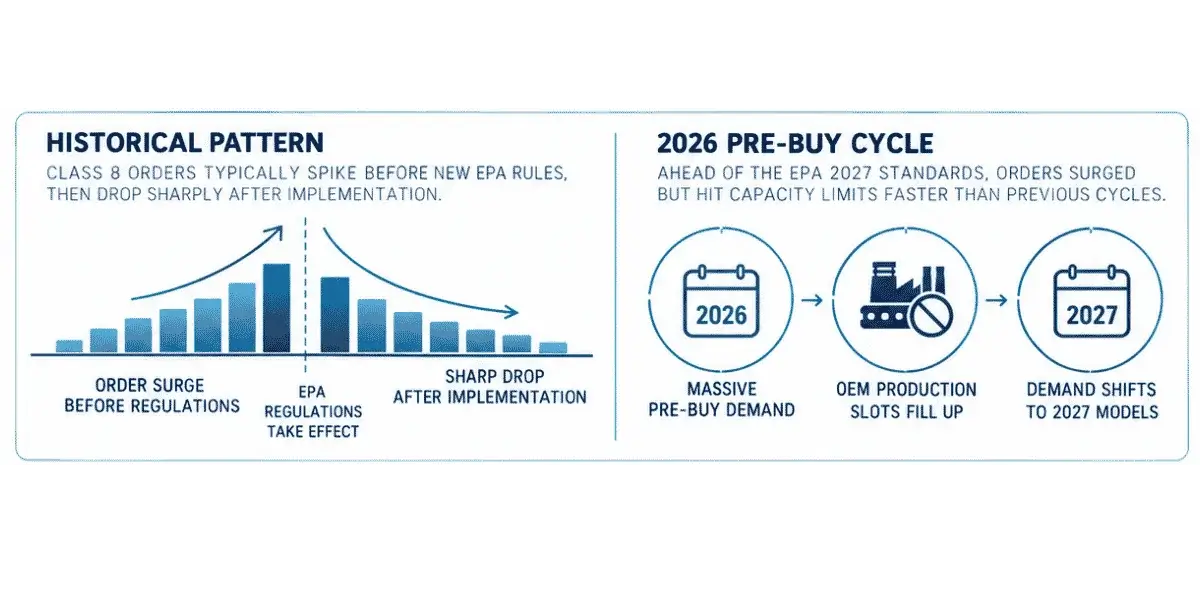
Historically, Class 8 pre-buy spikes occur like clockwork before major EPA shifts. Analyzing historical data from ACT Research shows massive order surges followed by severe demand drop-offs once new rules take effect. Understanding these historical patterns is exactly why the industry anticipated a massive 2026 pre-buy cycle ahead of the upcoming EPA 2027 truck regulations. However, this cycle hit capacity limits much faster than previous historical periods.
Significance for Truck Orders
Because the pre-buy window has closed prematurely due to capacity caps, new truck order patterns are shifting drastically according to analysts at FTR Transportation Intelligence. Fleets are being forced to rethink their purchasing timelines. Truckload carriers and major manufacturers like Volvo Trucks North America, Freightliner, and PACCAR are adjusting their order books as demand spills directly over into model-year 2027 vehicles.
💡 Fleet Tip: When new equipment availability tightens, keeping exact tabs on your current operational costs becomes critical. Check out our comprehensive guide on how to calculate total cost of ownership (TCO) for your trucks to pinpoint exactly where your money is going.
Factors That Closed the Pre-Buy Window Early
Several economic, regulatory, and supply chain constraints converged to shut down the 2026 pre-buy window much earlier than many anticipated.
Economic Influences on the Pre-Buy Market
While economic downturns or freight recessions can sometimes dampen pre-buy activity due to tight cash flows, the sheer scale of the looming 2027 cost increases triggered an unprecedented early stampede for trucks. Inflationary pressures on components and raw materials forced OEMs to cap their surcharge-free 2026 capacity early, closing order boards to protect their own manufacturing margins.
Regulatory Changes Triggering the Rush
The primary driver is the EPA’s Clean Truck Plan for 2027, which slashes allowable nitrogen oxide (NOx) emissions by more than 80% and extends regulatory emissions warranties. The sheer complexity and cost of these fully compliant engines triggered a massive rush to buy remaining model-year 2026 technology, completely exhausting OEM build slots. You can review the complete regulatory baseline directly on the EPA Clean Truck Plan informational portal.
Supply Chain Disruptions and Capacity Caps
Global supply chain disruptions and residual component shortages left truck manufacturers unable to ramp up production lines to satisfy the massive spike in pre-buy demand. Long lead times and volatile build schedules meant that once an OEM’s scheduled 2026 slots were booked, no additional capacity could be created, effectively locking latecomers out of the market.
Download Our Free Fleet Maintenance Resources Now!
Prevent costly breakdowns and maximize uptime with our free checklist.
Download
The Fleet Realities of a Closed Pre-Buy Window
With the pre-buy window closed, trucking companies face immediate operational and long-term financial hurdles.
Immediate Effects: The New Math of Fleet Procurement
Fleets that failed to secure 2026 slots are facing immediate financial strain if they must order new equipment. OEMs have transitioned their order books to model-year 2027 units, meaning buyers face a stark choice:
- Fully Compliant EPA 2027 Powertrains: An upfront price premium of $8,000 to $12,000 per truck due to advanced aftertreatment systems and extended emission warranties.
- Nonconformance Penalties (NCPs): If engine manufacturers use transitional penalties to sell non-compliant engines, those pass-through fees will cost fleets an estimated $6,000 to $7,000 per truck.
Long-Term Consequences: The Aging Fleet Risk
Over time, the closed pre-buy window will likely contribute to an aging fleet across the logistics sector. Because new trucks are dramatically more expensive, many fleet managers will choose to hold onto their existing vehicles longer. This strategy delays capital expenditure but requires a significant, immediate increase in maintenance investments to keep older trucks running efficiently.
💡 Fleet Tip: Running older trucks means you must catch problems before they turn into road failures. Instead of guessing, read our guide on how to leverage a customizable dashboard and AI fleet insights to let automated data analysis surface critical trends across your maintenance, fuel, and inspections before you even have to ask.
Changes in Truck Order Patterns
Instead of the massive, single-year order spikes typical of previous pre-buy eras, buying behaviors are fragmenting. Companies are shifting toward smaller, piecemeal orders, delaying replacements, or mixed-fleet strategies to blend compliant and non-compliant assets over a longer timeline.
How to Pivot: 3 Strategies for Fleet Managers
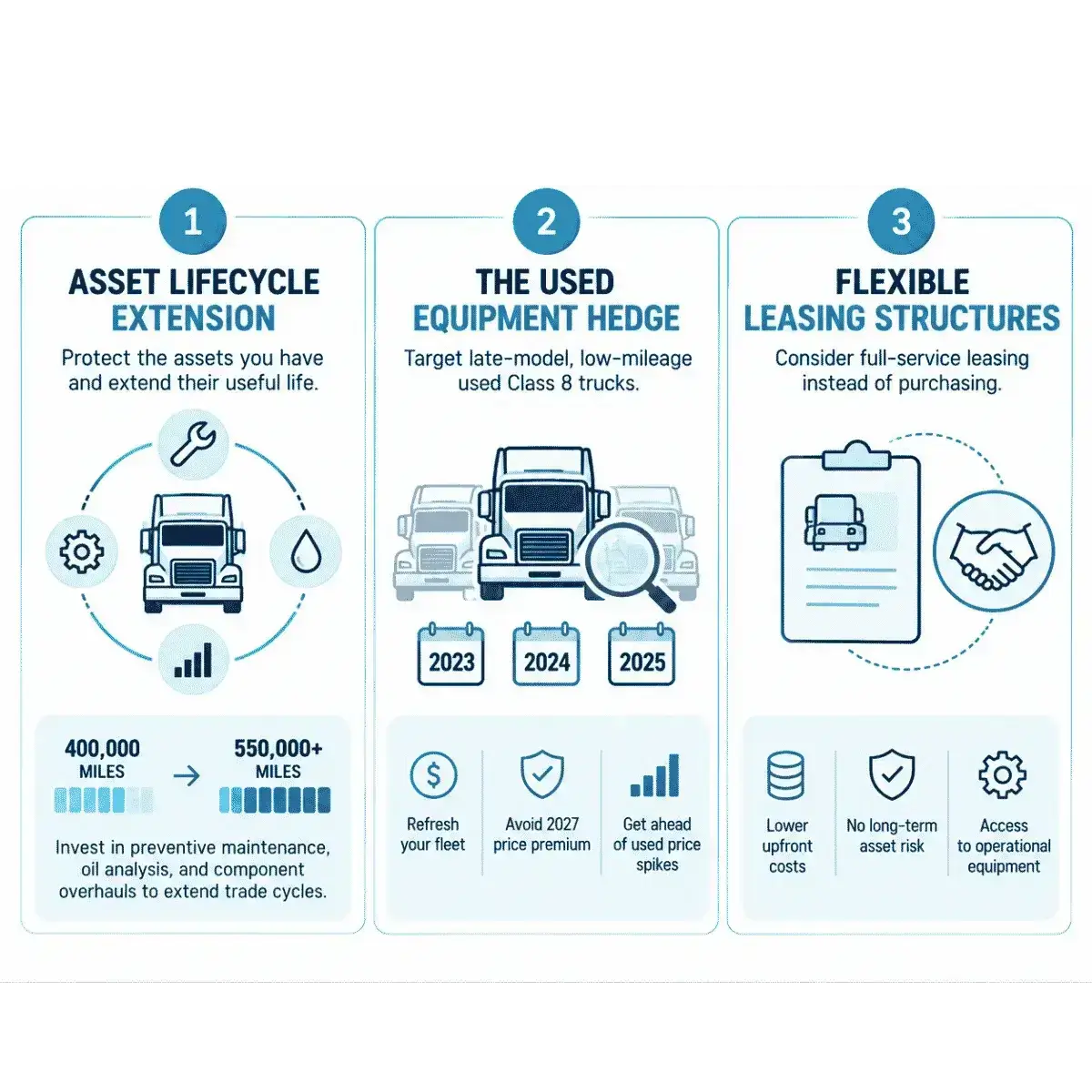
Adapting to a market without 2026 pre-buy options requires a proactive change in your fleet management playbook.
- Strategy 1: Asset Lifecycle Extension
If you cannot buy new without surcharges, protect the assets you have. Shift capital budget into aggressive preventive maintenance, advanced oil analysis, and component overhauls to extend your current trade cycles from 400,000 miles to 550,000+ miles without sacrificing reliability. - Strategy 2: The Used Equipment Hedge
Reallocate your procurement budget away from unavailable new models and target the late-model, low-mileage used Class 8 market. Acquiring clean 2023–2025 models allows you to refresh your fleet and completely bypass the EPA 2027 price premium before used truck prices spike from overflow demand. - Strategy 3: Flexible Leasing Structures
Explore full-service leasing arrangements rather than traditional equipment purchasing. Leasing provides access to operational equipment without the long-term asset risk or massive upfront capital premiums of unproven 2027 compliant technology.
💡 Fleet Tip: Whether you extend vehicle lifecycles or bring in used equipment, rigorous inspections are your frontline defense. Make sure your team is using a standardized, digital process by utilizing our ultimate vehicle inspection checklist guide to stop minor wear from turning into catastrophic failures.
Leveraging Technology to Optimize Your Transition
Embracing technology is no longer optional; it is your primary defense against rising equipment costs.
Utilizing Data Analytics for Triage
Deploy data analytics to evaluate your current trucks on a unit-by-unit basis. Identify exactly which vehicles are burning the most fuel or incurring the highest maintenance costs. This allows you to surgically replace only the worst-performing assets rather than doing a broad, expensive fleet refresh.
Advanced Fleet Management Systems
Implementing advanced telematics and fleet management systems helps maximize the utilization of your current trucks. By squeezing more efficiency and optimized routing out of fewer trucks, you can successfully reduce the total number of new equipment orders you need to place in a high-cost environment.
How Simply Fleet Helps You Navigate the Post-Pre-Buy Market
Navigating a closed pre-buy market means your operational efficiency must become your competitive advantage. This is exactly where Simply Fleet comes in. Our intuitive fleet management software empowers you to easily execute an asset lifecycle extension strategy by automating your preventive maintenance schedules, tracking every dollar spent on repairs, and digitizing your vehicle daily inspection reports (DVIR). Instead of worrying about unavailable 2026 build slots or looming 2027 upcharges, Simply Fleet gives you the real-time data visibility required to slash unexpected downtime, maximize the utilization of your current Class 8 assets, and protect your profit margins.
What's Next?
With the Class 8 pre-buy window officially behind us, successful fleet management comes down to agility. Fleet managers must stop looking for 2026 availability and focus heavily on optimizing operational costs, negotiating earliest-available 2027 positions, or hunting down clean used units.
Are you ready to adapt your procurement strategy and navigate the rigid realities of the post-pre-buy market with confidence?