





Protecting Last-Mile Delivery Margins Against Winter Surcharges: A Cost Per Mile Playbook
Key Takeaways
- Winterize HVAC service vans, technician equipment and dispatch procedures as separate tasks.
- Test batteries, traction, coolant protection, lighting and heating using vehicle-specific guidance.
- Keep RTU and cooling-tower servicing separate from vehicle inspections.
- Assign a responsible owner and repair follow-up for every failed winter check.
- Use the seasonal readiness checklist and maintenance history to review repeat cold-weather failures.
Winter preparation for an HVAC fleet is not just a tire inspection. A service company needs vans that start reliably, technicians who can work safely, and the right heating equipment and parts ready when a customer calls. The HVAC fleet winterization checklist should cover three connected areas: service vehicles, the tools and supplies they carry, and the dispatch decisions that keep field teams out of avoidable trouble.
Use this November checklist to assign inspections before the first severe cold snap, record failures, and close repairs before dispatch. It addresses service vans first. Rooftop units, cooling towers and customer HVAC systems need their own manufacturer-specific winter procedures. They are not substitutes for fleet maintenance.
HVAC Fleet Winterization Checklist: Start With the Service Vans
Inspect every van using one consistent checklist. Prioritize vehicles operating in the coldest territories, units with repeated no-start issues, and vans that carry emergency-call equipment. Capture the inspection date, vehicle, mileage, observed condition, technician responsible and repair status.
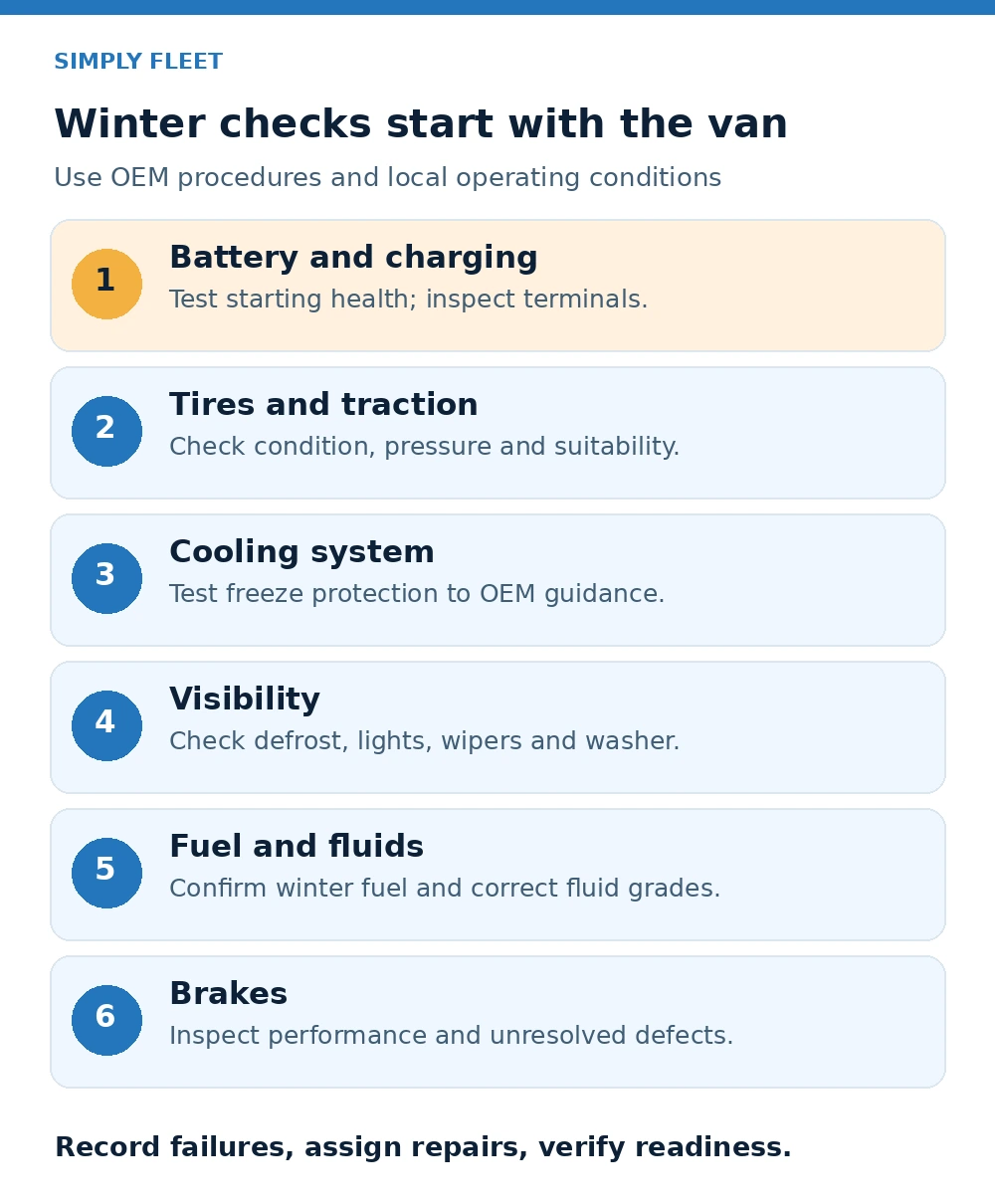
- Battery and charging: Load-test the starting battery using the battery and vehicle manufacturer's test procedure. Check terminals, alternator performance and parasitic draw when recurring no-start complaints suggest a fault. There is no universal minimum cold-cranking-amps rating for all HVAC vans.
- Tires and traction: Check load rating, tire condition, inflation at cold ambient temperature and tread depth. Apply the operating jurisdiction's rules and the tire manufacturer's winter traction guidance. Carry and practice fitting chains where required.
- Cooling system: Inspect leaks, hoses and coolant condition. Use a refractometer or approved tester to verify freeze protection against the local expected minimum. Do not assume every van needs a blanket minus-20-degree-Fahrenheit target.
- Heating and visibility: Confirm cab heat, defrosters, wipers, washer fluid, mirrors and exterior lighting. Replace worn components before a cold-weather dispatch.
- Fluids and filters: Check the OEM-specified winter oil viscosity, fuel and air filters, power steering components where applicable, and any scheduled services coming due.
- Brakes and underbody: Check brakes, lines, corrosion, chassis components and water exposure. Heavy vehicles with air brakes need appropriate air system and dryer checks.
Author's perspective: A checklist only works when failed items change the schedule
Finding a weak battery on Friday does not make Monday's first call safer unless somebody owns the repair and confirms the van is available. Fleet readiness is a handoff process, not an inspection completion percentage.
Diesel Service Vans: Cold Fuel, Block Heaters and Starting Reliability
Diesel cloud point and cold filter plugging behavior depend on fuel grade, regional winter blends and additives. There is no defensible universal temperature at which every diesel vehicle gels. Ask the supplier what winter grade is delivered, follow engine and additive manufacturer guidance, and avoid inventing additive ratios. Fuel that has already gelled may require professional recovery rather than a simple additive dose. For technical context, review diesel cold-weather guidance.
Where vehicles have block heaters, inspect the heater, cord, plug and electrical protection in accordance with OEM instructions. Do not improvise electrical connections. Note vehicles parked outdoors and their overnight charging or heating arrangements. Assign service to units with marginal starter systems before a cold morning exposes the problem.
Winterize the HVAC Tools and Parts Carried in Each Van
The service vehicle can be ready while the equipment inside it is not. Inspect battery-powered meters and tools, charging equipment, refrigerant recovery and diagnostic tools, test instruments, hoses, spare belts and safety supplies. Follow each instrument's storage and operating temperature instructions, including condensation precautions when moving devices between cold vans and warm buildings.
Maintain a practical list of frequently needed winter-call parts and identify which vans are expected to carry them. Track high-value assets and service equipment that move between technicians. For a connected asset approach, see Simply Fleet small equipment tracking and the digital inspection workflow.
Field HVAC Equipment Checks Are Different From Fleet Checks
If technicians also maintain customer rooftop units (RTUs), cooling towers or makeup air units, put those tasks in a separate customer-equipment job plan. Appropriate work can include inspecting freeze protection, verifying that freeze-stat controls operate, checking dampers and actuators, and reviewing dry-layup procedures. Exact freeze-stat settings, glycol concentrations and dry-layup steps depend on the equipment, fluid specification, climate, system design and manufacturer requirements. Have qualified HVAC personnel apply the equipment's service documents rather than copying a fleet checklist threshold.
The distinction matters: a van's engine coolant protection test cannot certify freeze protection in a building hydronic loop, and an RTU inspection cannot substitute for a vehicle pre-trip safety inspection.
Cold-Weather Dispatch Rules for HVAC Teams
Define who can postpone a route, who authorizes a vehicle change and how an emergency call is escalated. Use local weather warnings, road conditions and fleet condition reports. Prepare a technician PPE kit with insulated gloves appropriate to the job, layered clothing, traction footwear, high-visibility garments, phone power, a flashlight and practical emergency supplies.
Document the decision, not just the forecast. If the assigned vehicle has a safety-critical defect, route the job to a suitable available van and keep the defective asset out of dispatch until the responsible team has resolved and reviewed it.
Seasonal Fleet Readiness Checklist
Prevent costly breakdowns and maximize uptime with our free checklist.
Download
What HVAC Technicians on Reddit Say About Winter Van Readiness
In a discussion about driving a service van in snow, technicians described how quickly road conditions changed during service calls and why traction and the decision to postpone noncritical work mattered. These are individual experiences, not controlled testing or universal winter-driving guidance. For fleet managers, the practical lesson is to check tires and vehicle condition before the shift and empower dispatch to adjust assignments when conditions become unsafe.
Build November Preventive Maintenance Schedules and Follow-Up Records
Start preparation in early November where weather warrants, but set dates based on climate and fleet use. Group vehicles by operating region and service type. Assign inspection forms, due dates, service tasks, parts and the person responsible for the repair. Record completion evidence so an unresolved defect cannot disappear into a green-looking checklist.
Simply Fleet supports configurable vehicle inspections and preventive maintenance reminders. Its digital work orders, where available on the relevant plan, can help maintenance teams assign and document repairs. The software does not determine safety severity or automatically clear a vehicle for operation. Review and release decisions remain with your team.
Author's perspective: Look for the van that failed twice
Repeated no-start calls, the same heater fault, or recurring tire issues can reveal a weak repair handoff. A practical winter review should look at repeat service history, not just the most recent completed inspection.
Quick-Reference Winter Preparation by System
- Starting: OEM battery load test, terminals and charging check. Flag unresolved cold-start complaints.
- Traction: Condition, pressure, season-appropriate tires and local chain requirements.
- Fluids: Manufacturer-specified grade and tested freeze protection for the climate.
- Fuel: Confirm supplier winter blend and OEM-compatible cold-weather practices.
- Visibility: Heating, defrost, wipers, washer fluid and lights.
- Field equipment: Instrument condition, batteries, storage limits, spare parts and PPE.
- Dispatch: Weather triggers, spare vans, escalation and road safety decisions.
- Records: Responsible owner, due date, defect, corrective action, sign-off and service history.
For a ready-to-edit starting document, Simply Fleet offers a Seasonal Fleet Readiness Checklist. Our commercial winter driving guide also covers driver-level safety practices.
A Four-Week HVAC Fleet Winter Preparation Plan
- Week 1: Inventory vehicles, batteries, tires and high-risk routes. Identify units with repeat defects or overdue maintenance.
- Week 2: Inspect vans and the tools they carry. Assign work orders for failures and check supplier winter fuel availability.
- Week 3: Confirm repaired assets, check emergency supplies, and review alternate vehicle assignments and severe-weather rules.
- Week 4: Run a short simulated cold-weather dispatch review. Verify service histories, open defects and field readiness across locations.
Track the percentage of vehicles inspected, defects still open, time to repair, repeated cold-start complaints and vans available by depot. Those measures are more actionable than one network-wide winter-ready label.
Final Takeaway
An HVAC company cannot control the weather, but it can control what gets inspected, who owns a repair and which van is assigned. Start with the vehicles and tools that make emergency service possible, then connect field observations to maintenance follow-through.
HVAC FLEET WINTER READINESS
Keep your service vans ready for the next cold-weather call
See how Simply Fleet connects inspections, maintenance reminders, defects and repair history across your fleet.