





Best Fleet Fuel Management Systems in 2026: How to Choose (and What to Track)
Key Takeaways
- Investigate suspect MPG numbers before blaming a driver, fuel theft or vehicle failure.
- Wrong odometer readings, partial fill-ups and missing receipts can distort fuel efficiency.
- Separate pump-price changes from actual gallons consumed.
- Compare similar vehicles and duty cycles rather than one fleet-wide average.
- Use a seven-point audit to correct the records and investigate real cost changes.
A fleet fuel log can look complete while hiding expensive mistakes. One incorrect odometer, a partial fill marked full, a receipt entered twice, or an unrecorded purchase can make MPG and fuel cost per mile unreliable. Fleet managers may then chase a mechanical problem that is only a recording error, or miss a genuine fuel-use change because the baseline is wrong.
The fix is not to assume that every drop in fleet MPG means theft or a failing engine. Investigate the data first, isolate the source of the variance, and compare consistent records before spending money. This guide explains the financial misreading each common fuel-log error creates and the practical correction.
Why a Half-MPG Error Can Distort Your Fleet Budget
Consider a hypothetical fleet traveling 1,000,000 miles annually at 7.0 MPG. It would use about 142,857 gallons. At 6.5 MPG, the same mileage would imply about 153,846 gallons, a difference of roughly 10,989 gallons. At an illustrative $4 per gallon, that is about $43,956 in annual fuel exposure. These are arithmetic assumptions, not a claim about Simply Fleet customers or a guaranteed amount recoverable by correcting records.
That difference could come from changed loads, routes, weather, idling, maintenance or measurement error. A log discrepancy alone does not prove that the fleet spent the extra money. It tells the manager where the next investigation should begin.
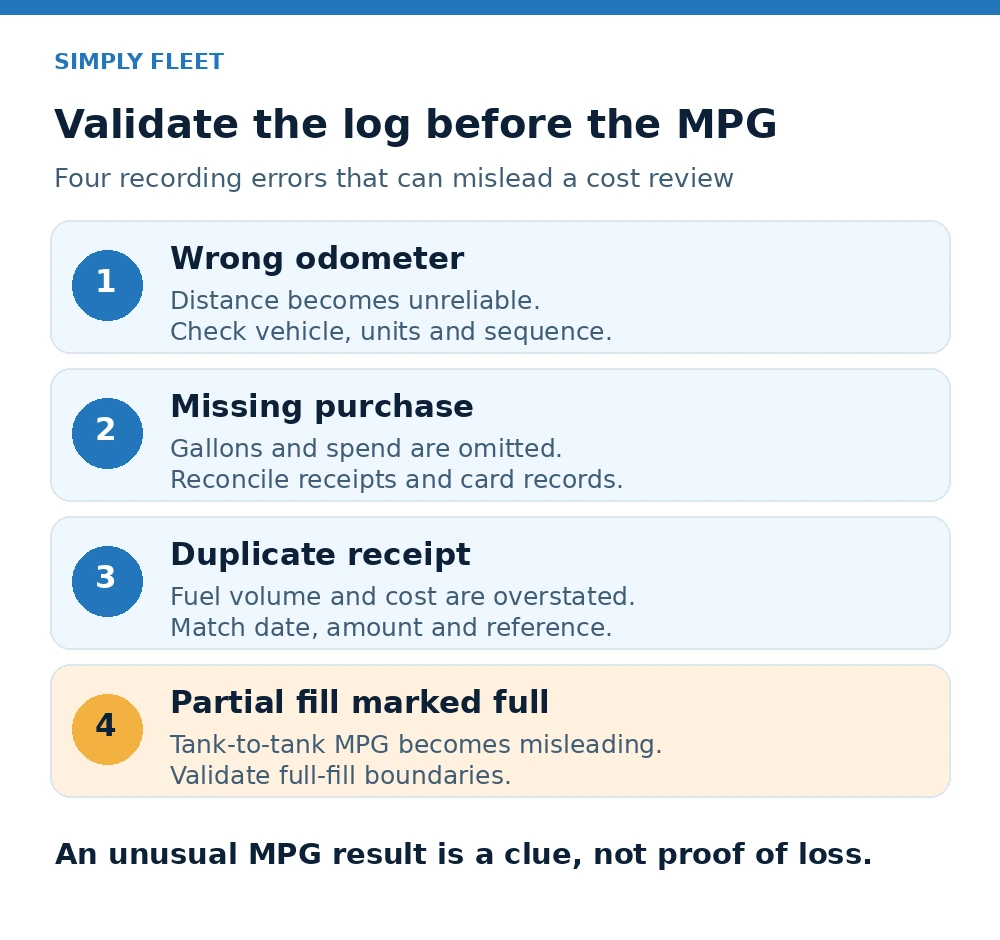
Mistake 1: Entering the Wrong Odometer Reading
The financial lie: An impossible distance between fill-ups can create an extreme MPG reading or make fuel efficiency look better than reality. A misplaced digit can also distort cost per mile and comparisons across vehicles.
Immediate fix: Confirm units, vehicle identity, recorded odometer and date against the dashboard or original receipt. Check whether a later entry was added out of sequence. Use a consistent process for manual corrections, and track who approved them.
Fuel records and daily mileage should agree on the vehicle and reporting period. Simply Fleet supports fuel fill-up logs and fuel efficiency tracking as well as daily mileage records. For compatible integrated telematics, mileage can be updated automatically when the configured option is enabled.
Mistake 2: Treating Partial Fill-Ups as Full Tanks
The financial lie: A partial fill may make the vehicle appear unusually efficient because the log does not know how much fuel remains in the tank.
Immediate fix: Mark a purchase as partial when the tank was not filled. Do not calculate or trust a tank-to-tank efficiency number until the next valid full-tank boundary and the intervening fuel quantity are accounted for. Simply Fleet's fuel management FAQ explains how partial and subsequent full fill-ups affect the calculation.
For reliable reports, require a clear tank-status entry. A driver should not have to guess whether a receipt means the tank was filled completely.
Mistake 3: Missing a Fuel Purchase
The financial lie: Missing gallons can inflate MPG, hide fuel spending and make the next logged fill-up appear inconsistent.
Immediate fix: Reconcile card transactions, receipts and driver entries. Add the missing record to the correct vehicle and date. Where a previous purchase was missed, use the documented Missed Previous Fill Up option in Simply Fleet when appropriate so the efficiency series is recalculated rather than silently continued with incomplete data.
Mistake 4: Double-Entering a Receipt or Mixing Units
The financial lie: Duplicate transactions overstate fuel spend and can make efficiency collapse. Confusing liters and US or UK gallons can create larger distortions even though each entry looks valid in isolation.
Immediate fix: Match date, station, amount, volume, receipt ID and card reference. Standardize unit reporting in the monthly dataset. Keep an exception list instead of deleting suspicious entries without an audit trail. A mobile receipt scanner can reduce retyping, but extracted details still need review before saving.
Author's perspective: The missing field is usually more expensive than the typo
A useful fuel log captures enough context to investigate unusual spending. Vehicle, odometer, fuel volume, tank status, purchase amount and date let a manager distinguish a true change in consumption from an incomplete record. A perfect-looking spreadsheet without those fields is not a reliable baseline.
Mistake 5: Mixing Pump-Price Changes With Fuel-Consumption Changes
The financial lie: A higher fuel bill may be labeled a driving-efficiency problem when local fuel prices rose, or a consumption problem may be hidden by cheaper fuel.
Immediate fix: Break changes into price per gallon, gallons per 100 miles, total miles and total cost. Compare those measures separately before discussing corrective actions. The US Energy Information Administration provides public fuel price context for US fleets.
If gallons per 100 miles rise with price unchanged, inspect vehicle use, loads, route conditions, idling and maintenance. If gallons remain stable and prices rise, review purchasing and budget assumptions instead.
Fuel Log tracker
Prevent costly breakdowns and maximize uptime with our free checklist.
Download
Mistake 6: Averaging MPG Across Dissimilar Vehicles
The financial lie: A high-mileage highway truck and an urban stop-and-go vehicle are treated as though their expected consumption should match. A change in fleet mix can shift the network average without any one unit getting worse.
Immediate fix: Segment comparable vehicles by class, load, operating territory, duty cycle and reporting period. Investigate each unit against its own history before ranking the network. For a deeper measurement framework, see winter fuel surcharge and consumption tracking and Simply Fleet's fuel management overview.
Mistake 7: Ignoring Idling, Maintenance and the Vehicle's Service History
The financial lie: Every MPG drop is attributed to driver behavior, with no review of tire condition, filters, engine issues, increased idle time, route changes or weather.
Immediate fix: Check whether the decline is confirmed by valid fuel records. Compare recent service history, vehicle issues, loads and driving pattern. Where supported, combine telematics idle-time or engine data with recorded fill-ups. Simply Fleet's fuel records alone should not be described as an idle-time sensor or fuel-theft detector.
What Truck Drivers on Reddit Reveal About Real-World MPG
In a Reddit discussion comparing quarterly MPG with IFTA fuel records, drivers described materially different results based on truck type, loads, headwinds and idling. These are personal reports, not controlled benchmarks, but they illustrate why comparing two raw MPG figures without duty-cycle context can mislead managers. The operational answer is to reconcile receipts and mileage first, then compare similar vehicles and routes rather than accusing a driver because their number differs from another truck's.
A Seven-Point Fleet Fuel Log Audit
- Check vehicle IDs. Each purchase must map to the right vehicle and reporting period.
- Confirm odometer sequence. Flag sudden reversals, unexplained jumps and unit mismatches.
- Reconcile transactions. Compare card statements, receipts and saved fill-up entries to find missing or duplicated purchases.
- Flag partial fills. Validate tank status and calculate MPG only across a suitable full-fill interval.
- Separate price and volume. Compare gallons used, cost per gallon and distance separately.
- Compare like with like. Review similar vehicles and operations against prior baselines.
- Assign exceptions. Record the issue, person responsible, correction and follow-up date.
A useful monthly exception report should include missing receipts, duplicate candidates, improbable odometer changes, partial-fill sequences and unusual consumption that remains after data checks. Use the free Fuel Log tracker as a starting worksheet if your team is not yet ready for dedicated fuel software.
Author's perspective: Audit the cause before assigning blame
Reliable cost control is a data workflow. Before asking a driver or mechanic to explain a poor MPG result, ensure the measured distance and fuel volume are comparable. That one discipline can prevent wasted inspections and more productive conversations with the operations team.
How Simply Fleet Helps Keep Fuel Records Consistent
Simply Fleet supports fuel fill-up entries, odometer and fuel quantity logging, manual or AI-assisted receipt capture, partial-tank flags, missed-fill-up handling and fuel-efficiency reports. Its service and maintenance history can help managers investigate vehicles with repeated, independently verified consumption changes. It does not independently prove theft or diagnose a mechanical fault.
Set a simple driver entry standard and review exceptions consistently. The software helps preserve a usable history, but the accuracy still depends on how the team captures and reviews each transaction.
The Bottom Line
A suspicious MPG number is a clue, not a conclusion. Correct fuel records before treating an efficiency change as mechanical failure, purchase misuse or a driver problem. The most expensive habit is not the occasional typo. It is allowing the same incomplete data to guide expensive operating decisions month after month.